Relevance 10/10Importance 10/10
Google unveiled Gemini 4 Argon, its new frontier model targeting real-world coding, enterprise knowledge work, and — unusually — cyber defense. It posts a DeepSWE v1.1 score of 77.9%, ties for first on CWE-bench v1 at 68% for remediating security vulnerabilities, and pushes the output token limit to a full 1M, up from 64K. Launch pricing is $2 per million input tokens and $10 per million output, with cached input at 95% off, and it's shipping first to trusted testers and cyber defenders via the Fairwind Program — notably without cyber guardrails for that cohort.
Relevance 10/10Importance 9/10
Earendil publicly reversed its opposition to the Model Context Protocol, announcing MCP support in the core of its Pi agent tool. The realization: both MCP and Pi needed the same underlying infrastructure — a JavaScript sandbox for tool orchestration — so they wired MCP into a feature called Codemode that lets agents compose tool calls more flexibly. Their framing is pragmatic rather than apologetic: the best way to influence something is to embrace it, and they still think MCP's tool-composition story needs work.
Relevance 10/10Importance 7/10
Magnitude is an open-source inference engine that compiles and tunes GPU kernels on your specific device before models run, rather than shipping precompiled kernels like llama.cpp. Anders and Tom claim up to 2x faster performance, built entirely in Rust with custom kernels, dynamic memory allocation, and hybrid paged attention for concurrent sessions. It ships as a desktop app with one-click integration into Pi, OpenCode, and Hermes, runs fully local for privacy, and supports Apple Silicon, NVIDIA, AMD, and CPU-only machines.
Relevance 9/10Importance 7/10
Artificial Analysis put Argon through its independent benchmark suite and scored it 53 on the Intelligence Index, ranking 8th out of 223 models tracked and well above average among reasoning models. It's a chatty one — 110M output tokens against a median of 82M — which matters when you're paying $10 per million out. Average cost works out to $1.99 per Intelligence Index evaluation task.
Relevance 9/10Importance 6/10
HN spotted that OpenAI's Codex pricing page now lists unlimited GPT-5.6 usage on the Pro tier. The ladder runs Free, $8 Go, $20 Plus, then Pro at $100 for the 5x tier and $200 for 20x, plus Business at $20 per user. Worth noting: new sign-ups and upgrades to the $200 Pro tier were paused back on September 10, so "unlimited" comes with a closed door attached.
Relevance 7/10Importance 7/10
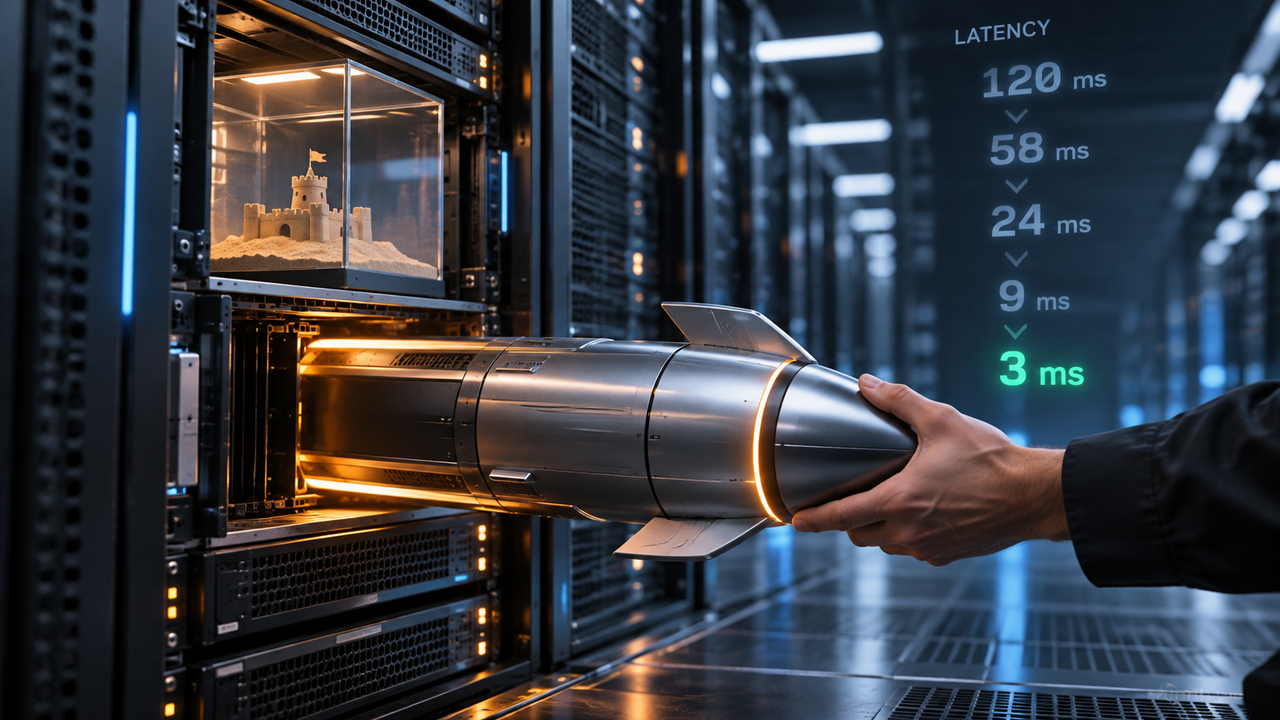
Netlify rebuilt Edge Functions from the ground up, swapping V8 isolates for Firecracker MicroVMs running on its own network. The motivation was threefold: raw performance, stronger security isolation between customers, and control over the platform instead of renting someone else's runtime. Median latency dropped to roughly 5 to 6 milliseconds from 25 to 40, p99 invocations got 47.4% faster, and they're reporting 99.998% availability.
Relevance 5/10Importance 8/10
The Edison Design Group's C++ front-end — the only production-quality source-to-source C++ engine of its kind, and the quiet foundation under three decades of industrial compilers — went public today. As of September 30, 2026, the proprietary code moves into an open repository under The C++ Alliance's stewardship, shifting from commercial licensing to community-driven development funded by tax-deductible contributions. For tooling authors this is enormous: production-grade standards-compliant C++ parsing without vendor lock-in.
Relevance 4/10Importance 6/10
Allison Marsh's Past Forward column traces the Bloomberg Terminal back through the whole lineage of financial data hardware — Edward Calahan's 1867 telegraphic ticker-tape machine, Edison's improved patent in 1871, and Quotron's electronic quote screens in 1960. Those two decades of quote-distribution innovation set the stage for what Bloomberg would do to the trading desk. The through-line is a good reminder that the most durable product in finance is a purpose-built proprietary terminal that nobody has managed to unbundle.
Relevance 4/10Importance 4/10
Matt Keeter's Halfspace is an experimental IDE for solid modeling built on his Fidget geometry kernel, doing real-time rasterization and meshing of implicit surface models. It deliberately puts distance field visualization front and center so designers can spot discontinuities that wreck rendering — problems that stay invisible if you only look at sign information. The stack is Rust plus WebGPU plus scripting, running natively on both web and desktop, and the demands of real use are feeding fixes back into Fidget itself.
Relevance 3/10Importance 5/10
Quanta reports that brain waves are considerably weirder than the textbook oscillation model — researchers are seeing spiral patterns and concentric waves that appear to reorganize neural activity in real time based on what the task demands. Joshua Jacobs and Anup Das used high-resolution intracranial electrodes in epilepsy patients during memory tasks and found that rotating waves correlate with more complex memory behavior than simpler wave structures. The implication is a flexible coordination layer riding on top of fixed anatomical wiring, operating on the timescale of behavior itself.

 HN Briefing PM