Relevance 10/10Importance 8/10
Cactus shipped a family of on-device foundation models that fit in a single 8-to-29MB binary and handle function calling, structured JSON extraction, and embeddings entirely locally. Built on their Simple Attention Network architecture with "intelligence laddering," every depth from 2 to 20 layers is a deployable model, and they claim the 4-layer variant matches DeepSeek V4 Flash when fine-tuned. It clocks 400 to 4,000 tokens per second decode on a Raspberry Pi 5 and runs on iOS, Android, browsers, and embedded targets.
Relevance 10/10Importance 8/10
Researchers propose letting models talk to each other through their KV-caches instead of through generated text, using a neural projector to fuse a source model's cache into a target model's and a learnable gate to pick which layers benefit. The result is 6.4 to 14.2 percent higher average accuracy than individual models and 3.1 to 5.4 percent over text-based handoffs. Critically, it delivers an average 2.5x latency speedup by skipping intermediate token generation altogether.
Relevance 9/10Importance 7/10
The argument is that LLMs belong in the copyeditor's chair, never the ghostwriter's, with two hard rules: don't use a single word the model suggests, and ignore its praise entirely. Models are genuinely good at the tedious mechanical pass — passive voice, filler words, paragraph placement — the stuff humans hate doing. The suggested workflow is write it yourself, let the model flag problems, rewrite the passage yourself, and compare without telling the model what you changed.
Relevance 9/10Importance 7/10
The paper coins "linguistic illegibility" for the gap between what a model says about its reasoning and the actual math happening in activation space. If that gap is real, then chain-of-thought monitoring and constitutional self-critique can never be fully trusted as security controls. The proposed floor is non-linguistic: taint tracking that prevents model-generated data from touching sensitive state, plus hard virtualization and third-party audits of sandbox config.
Relevance 9/10Importance 6/10
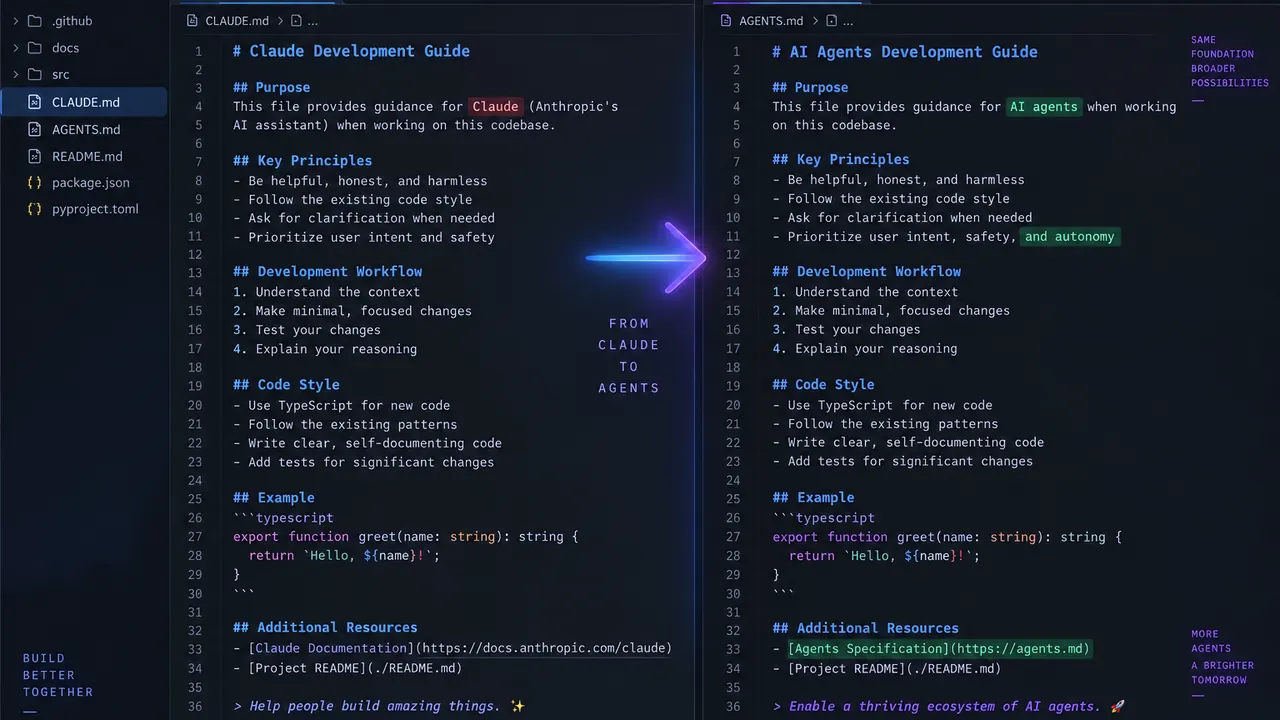
Version 2.1.277, shipped today, makes Claude Code fall back to reading AGENTS.md in projects that have no CLAUDE.md, configurable under Project instructions in /config. It's a quiet nod toward the cross-tool agent-instructions convention, though it's not live on Bedrock, Vertex, or Foundry yet. The same release carries over a hundred fixes including subagent output framing, session corruption repairs, and MCP reconnection issues.
Relevance 7/10Importance 8/10
Quick Tunnels turn a local server into a public encrypted HTTPS URL in about three seconds, with no account, no DNS setup, and no open inbound ports. The connection is outbound-only into Cloudflare's edge across 335-plus cities, with automatic TLS and DDoS protection along for the ride. Cloudflare is explicitly pitching it at coding agents that need ephemeral webhook-ready URLs for previews, CI, and eval loops.
Relevance 5/10Importance 8/10
Cloudflare took a statistics pass at the consistent hashing inside their Pingora-based load balancer and found a lot of fat. They compacted each hash point from 8 bytes to 6 for a flat 25 percent win, then cut the number of hashes per server by 90 percent after the math showed diminishing returns past a threshold. Rolled out carefully across data centers, the two changes freed 100 terabytes of RAM globally with no meaningful hit to load distribution.
Relevance 4/10Importance 8/10
GrapheneOS flagged that Android 17 QPR1 adds new developer-facing APIs without a corresponding AOSP release — the first time that's happened since Honeycomb. The new capabilities are Pixel OS exclusive, leaving every other manufacturer and every AOSP fork without them. It's a meaningful departure from Android's open-source release norms and a real question mark for anyone building on the open platform.
Relevance 3/10Importance 7/10
Ledger Donjon used photon-emission microscopy to physically locate the DEBUGEN register on an RP2350, then fired a laser at it to flip bits and restore Secure debug access despite permanent disable flags. A rescue reset kept the firmware from re-applying runtime locks, and they walked out with a secret pulled from one-time-programmable memory. Every individual protection worked as designed — the bypass lives in how they interact, and it takes roughly a quarter million dollars of gear.
Relevance 2/10Importance 5/10
Xcode 27.1 beta bundles Swift 6.4 and SDKs for the iOS 27.1 through visionOS 27 lineup, and requires macOS Tahoe 26.6 or later. The headline new feature is modest — a Display group in the Previews canvas overrides picker for alternative device displays. The known-issues list is the real story: Mac Catalyst breaks on iOS 27.1 APIs, and the new iPhone Duo Simulator runtime can't debug most app extensions.

 HN Briefing PM