Relevance 10/10Importance 9/10
DeepSeek shipped a Search API and a Fetch API aimed squarely at agents and RAG pipelines, with Fetch returning any single web page rendered as clean Markdown. Both are priced at seventy-five cents per thousand successful requests with account-level limits of five requests per second each. That's aggressive enough pricing to put real margin pressure on the existing agentic-search tooling market.
Relevance 10/10Importance 7/10
Sphinx is a Git hook that intercepts your push and interrogates you about what the changed code actually does in edge cases and failure modes before letting it through. The premise is that if you can't explain the diff your agent wrote, you shouldn't be shipping it. It works with Claude Code and Cursor, runs on minimal tokens, and keeps answers and credentials local.
Relevance 9/10Importance 9/10
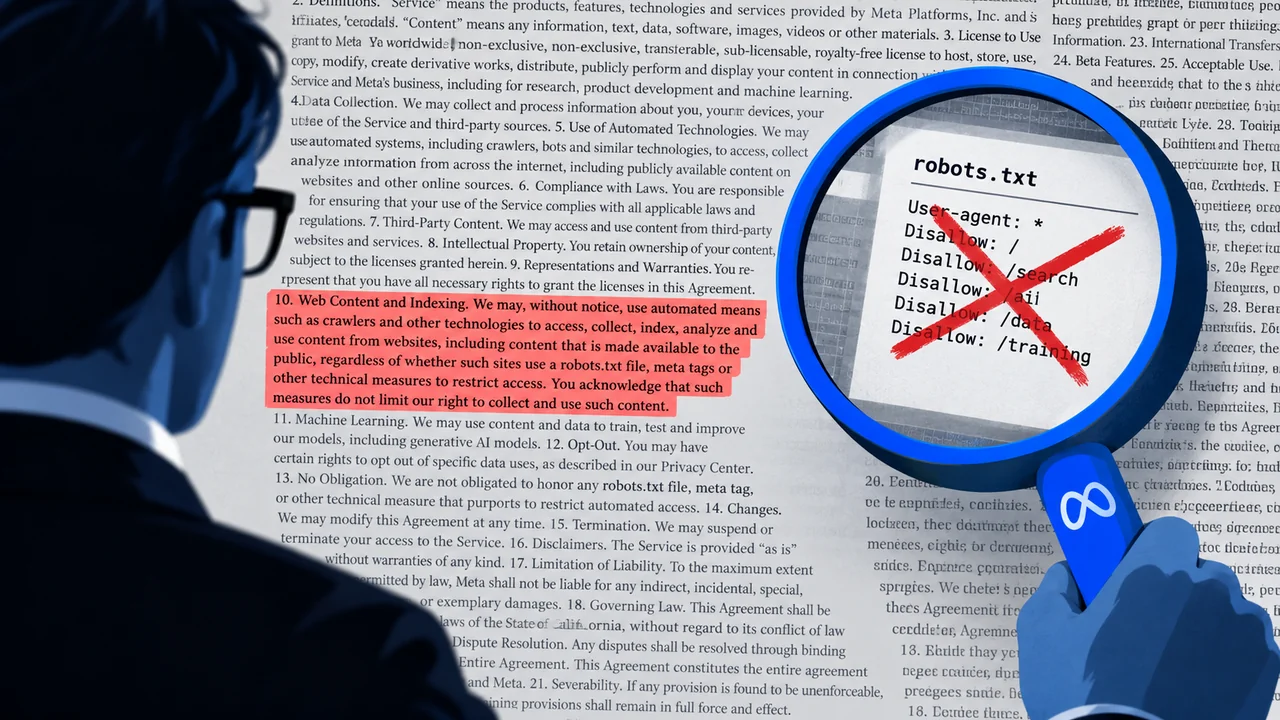
After Nieman Lab exposed the original language, Meta revised its commercial terms to strip the word "train" and narrow usage to advertising and business products — but lawyers say the rewrite still permits sweeping scraping of any site "associated with" a business account, potentially overriding robots.txt. Attorney Matt Topic notes Meta can still use scraped content to develop any "business product," and experts flag that the terms would technically let Meta register as a fake user to get past registration walls. The terms hit October 30 and there's no opt-out for business accounts.
Relevance 8/10Importance 7/10
This teardown argues the Holmes documentary is itself a masterclass in the manipulation it claims to document, using camera angles, close-ups, editing rhythm, and information sequencing to repeatedly flip viewer sympathy across three hours. The author's thesis: a photograph is shaped more by the person behind the camera than by what's in front of it. HN loved it — 293 comments and counting, mostly arguing about founder mythology and who gets redemption arcs.
Relevance 6/10Importance 6/10
A clean, practical walkthrough of parser combinators as a functional alternative to regex for pulling structure out of text. The author composes tiny parsers using pSeq, pMap, and pRepeat to build a complete parser for ping command output — something the post argues would be an unreadable mess as a regex.
Relevance 6/10Importance 6/10
An open-source motorized XYZ stage hitting sub-micrometer precision for optical alignment, microscopy, and component probing. It uses parallel kinematics with stepper actuation, closed-loop control at 30 kilohertz, and a magnetic gearing trick that multiplies encoder resolution 30x to land 50-nanometer steps. Drives over USB serial with G-code and a full look-ahead motion planner.
Relevance 6/10Importance 6/10
The μRepRap is an open-source micron-scale 3D printer targeting repeatable positioning better than 3 micrometers using commonly available materials. The dual goal is a macro-scale machine that fabricates at micron scale, while developing the techniques needed for eventual microscale self-replication. It's the RepRap democratization playbook, pointed at precision manufacturing.
Relevance 3/10Importance 9/10
Stanford researchers discovered by accident in 2025 that a bleached coral fragment resting against a healthy one begins regaining color where they touch — the two fuse, forming channels that ferry symbiotic algae and nutrients across. Five days of contact triggers full recovery within seven weeks, a technique the team calls "helping hands," published in Science Advances on October 14. The catch: it only works between corals sharing the same genet, since mixed pairings trigger stinging cells in something like organ rejection.
Relevance 3/10Importance 3/10
An interactive map of Nintendo's official Zelda timeline, tracing the three branches that split after Ocarina of Time — child era, adult era, and the fallen-hero line. It walks each game's story, characters, and connections from the creation of the world through Tears of the Kingdom.
Relevance 1/10Importance 3/10
Hatching is a conventional system for rendering heraldic tinctures in monochrome using dots and lines, so coats of arms survive reproduction as engravings, woodcuts, and seals. It emerged in the Renaissance and was standardized in the 1630s by Silvester Petra Sancta and Marcus Vulson de la Colombière. Essentially a 400-year-old lossless color encoding scheme for a one-bit medium.

 HN Briefing AM