Relevance 9/10Importance 10/10
A remote, unauthenticated use-after-free in Linux's IPv4 TCP handshake lets an attacker read or corrupt kernel memory before any application-level auth happens, affecting kernels from 4.4 all the way up. It was reported by Xinyang Ge at Anthropic and fixed by Eric Dumazet in a four-line patch swapping `kfree()` for `kfree_rcu()` — and notably, Claude built a working remote root exploit against a multipath TCP listener in under an hour. Most distros hadn't shipped patches at time of writing; the interim mitigation is dropping TCP packets carrying IPv4 options via netfilter.
Relevance 10/10Importance 7/10
Andrej Karpathy used Claude Opus 5.5 to mine Hacker News comments for video links, distilling 40,000 recommendations down to 6,454 curated videos across 150 topics spanning 2007 to 2026, with Sonnet handling spam filtering. The result is an algorithm-free YouTube front end with local-only "ForYou" recommendations, no accounts, keyboard shortcuts, and data export. He built the whole thing in roughly two hours.
Relevance 8/10Importance 9/10
Kyle Kingsbury put ParticleDB — Orkes' Rust-based multi-model database pitched squarely at AI workloads — through Jepsen and found 96 distinct issues, many on a single node with no fault injection at all. Unique and null constraints went unenforced, duplicate and NULL primary keys slipped through, `WHERE 4 = 5` matched rows, dropped tables resurrected, and committed writes were lost in the default config despite "full ACID" and "formally proven" marketing. Jepsen's recommendation is blunt: halt deployment and migrate off.
Relevance 5/10Importance 7/10
A deep dive showing that query engine bottlenecks are memory stalls, not CPU — a modern core can retire 400 to 800 instructions in the time one RAM access takes. A naive GROUP BY over 17 million distinct UserIDs spent 50.1% of its cycles stalled and pulled 4.5GB from DRAM; radix-partitioning into 4,096 cache-sized HashMaps cut stalls to 23.5% and DRAM traffic to 1.5GB. Single-core query time dropped from 3.6 seconds to 2.7, and eventually to 1.8 — by doing *more* CPU work, not less.
Relevance 7/10Importance 4/10
BootGPT crams a character-level neural net inference engine into 512 bytes of hand-written x86 assembly in the MBR, with an 11.5KB int8-quantized model loaded off the next 23 disk sectors. It runs in 16-bit real mode on a 386 with no OS and no runtime, using BIOS interrupts for disk reads and printing, and an LCG seeded off the system timer for sampling. Boot the image and your machine generates plausible-looking fake Linux dmesg output forever.
Relevance 3/10Importance 7/10
Molly, the hardened Signal-for-Android fork offering database encryption and degoogled notifications, hasn't shipped a release since July 31, 2026. That means it's still exposed to an October disclosure where audio and possibly video can keep streaming after you hang up — something upstream Signal patched in 8.27. Commenters are pointing users toward official Signal APKs, Signal-FOSS by Twinhelix, or Obtainium for update tracking.
Relevance 4/10Importance 6/10
Colin Percival argues that holding knowledge isn't enough — scholars have an affirmative obligation to find the people who need it and tell them, rather than hiding behind "nobody asked." He grounds it in his own 2004-2005 Intel Hyper-Threading side-channel discovery, where he spent six months on quiet coordinated disclosure before going public. He leans on Fichte's 1794 lectures but strips out the elitism, locating the duty in the knowledge itself rather than in social class.
Relevance 4/10Importance 5/10
Python's `None` is overloaded to mean missing, unset, errored, and sometimes an actual legitimate value — which is exactly why a cache can't tell a missing key from one that maps to `None`. Sentinels fix this by living outside the domain of valid values so they can never collide. Python 3.15 ships a built-in `sentinel()` function, retiring the old `object()` and `Enum` hacks, and type checkers can now narrow sentinel types the way they do `None`.
Relevance 3/10Importance 3/10
Vocabulary coverage stats wildly oversell comprehension: the 500 most common words cover 85.9% of the dialogue in Frieren, but only 38.4% of complete lines. Average lines run about seven words, so you need every single one to land the thought — the probabilities compound against you. Across eight shows, Serial Experiments Lain needed just 401 words for 50% line comprehension while Jujutsu Kaisen demanded 980, and 50 to 64% of missed lines had exactly one unknown word.
Relevance 2/10Importance 3/10
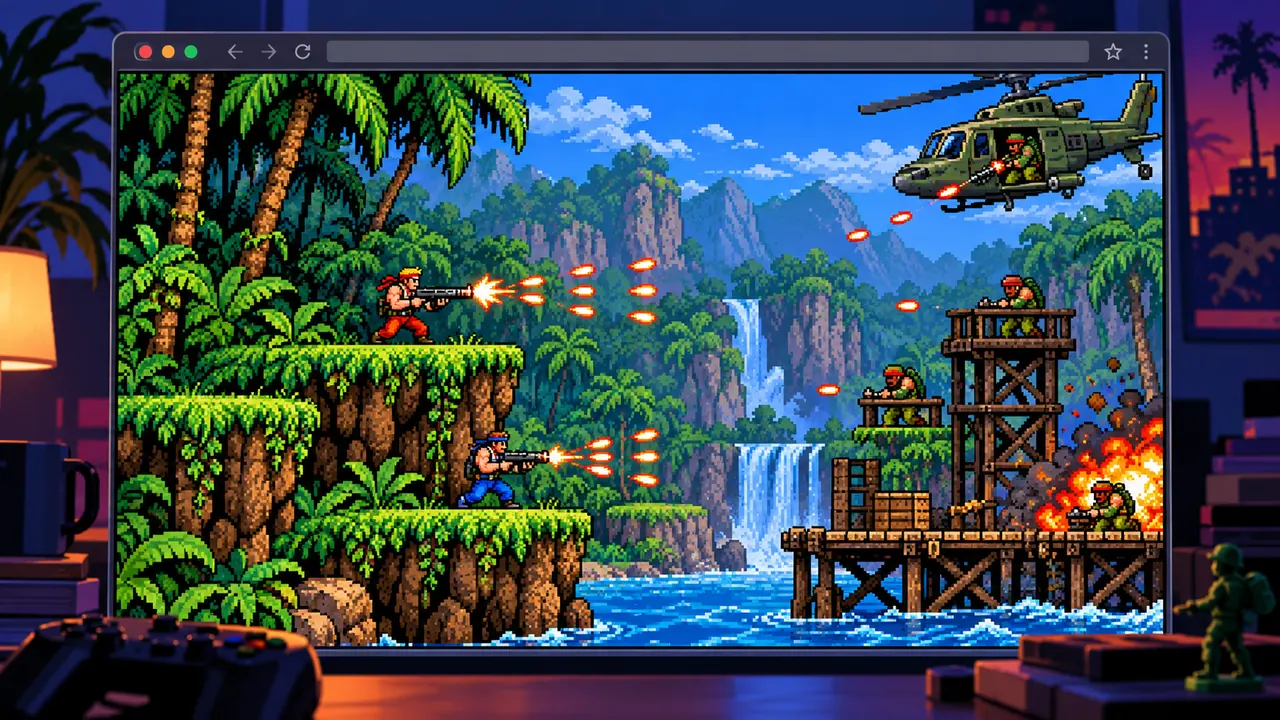
Someone took the original 1987 NES Contra 6502 assembly, lifted it to C, then compiled that to WebAssembly so it runs natively in a browser with no emulator download. It supports local single-player plus online two-player co-op, where one player hosts and the other joins by invite link. Arrow keys move, space jumps, S fires — and yes, you still only get three lives.

 HN Briefing PM