Relevance 9/10Importance 9/10
A federal judge ruled against Google's effort to use DMCA Section 1201 to stop SerpAPI from scraping its search results, finding that Google's SearchGuard CAPTCHA doesn't qualify as a technological protection measure because it doesn't specifically protect copyrighted works. The ruling is a meaningful legal limit on using copyright law as a weapon against scrapers, with direct implications for AI training data access. The irony wasn't lost on HN: Google built its empire by crawling others' content freely, and is now on the other side of that argument.
Relevance 9/10Importance 6/10
Feyn released FeyNoBg, a background removal model that handles hard cases like camouflage, motion blur, fine hair, and bicycle spokes using per-pixel opacity prediction. The team used interpretability work to identify that expanding a single transformer stage from 18 to 24 blocks was the key bottleneck for both localization and boundary precision, growing the model from 222M to 263M parameters while preserving pretrained weights. FeyNoBg tops published S-measure benchmarks on four out of eight standard matting tests, and an open-source Python library called NoBg unifies training, preprocessing, and evaluation behind a single interface.
Relevance 4/10Importance 8/10
A security researcher found unauthenticated API vulnerabilities in the My Eicher fleet management platform used by Volvo/Eicher commercial trucks in India, exposing data on 748,000 customers and 676,000 vehicles. The most severe finding: 2.5 million stored OTPs dating back to 2021 were accessible without authentication, enabling account takeover and thus remote control of entire commercial truck fleets. The researcher disclosed to VECV in November 2025; the primary fix landed within weeks, with the full writeup published today after responsible disclosure.
Relevance 6/10Importance 6/10
Rise Reforming, a YC S26 startup founded by University of Chicago molecular engineers, converts biogas from landfills, farms, and wastewater plants into high-value chemicals like dimethyl ether and methanol using a modular on-site reforming process. Their patent-pending bi-reforming reaction addresses supply chain fragility exposed by events like Winter Storm Uri, which wiped 60% of U.S. organic chemical output in one freeze, and Iran sanctions that spiked global methanol prices. The team has broken ground on a pilot plant at a Chicagoland wastewater facility, targeting Q1 2027 commissioning with cosmetics-grade DME as the beachhead market.
Relevance 6/10Importance 5/10
Python Standalone Builds produces self-contained CPython distributions that bundle the standard library so the interpreter runs across same-architecture systems with minimal system dependencies. The project underpins widely-used developer tools including uv and pyenv, providing a reliable portable CPython base for embedding Python in applications or shipping standalone executables. Rich build metadata lets downstream tools like PyOxidizer customize distributions for specific deployment needs without starting from scratch.
Relevance 4/10Importance 5/10
AMD GPUOpen describes a technique that wraps high-res meshes in low-polygon tetrahedral cages that animate at runtime, while the dense underlying geometry stays static in a pre-built BVH acceleration structure, eliminating per-frame rebuilds. When a ray hits an animated cage, it transforms into rest-pose space to query the static BVH, enabling real-time ray tracing of 585 million animated triangles at 60 fps on a Radeon RX 9070 XT. The method is best suited for connectivity-preserving animations like vegetation, crowds, and distant characters in open-world rendering pipelines.
Relevance 3/10Importance 5/10
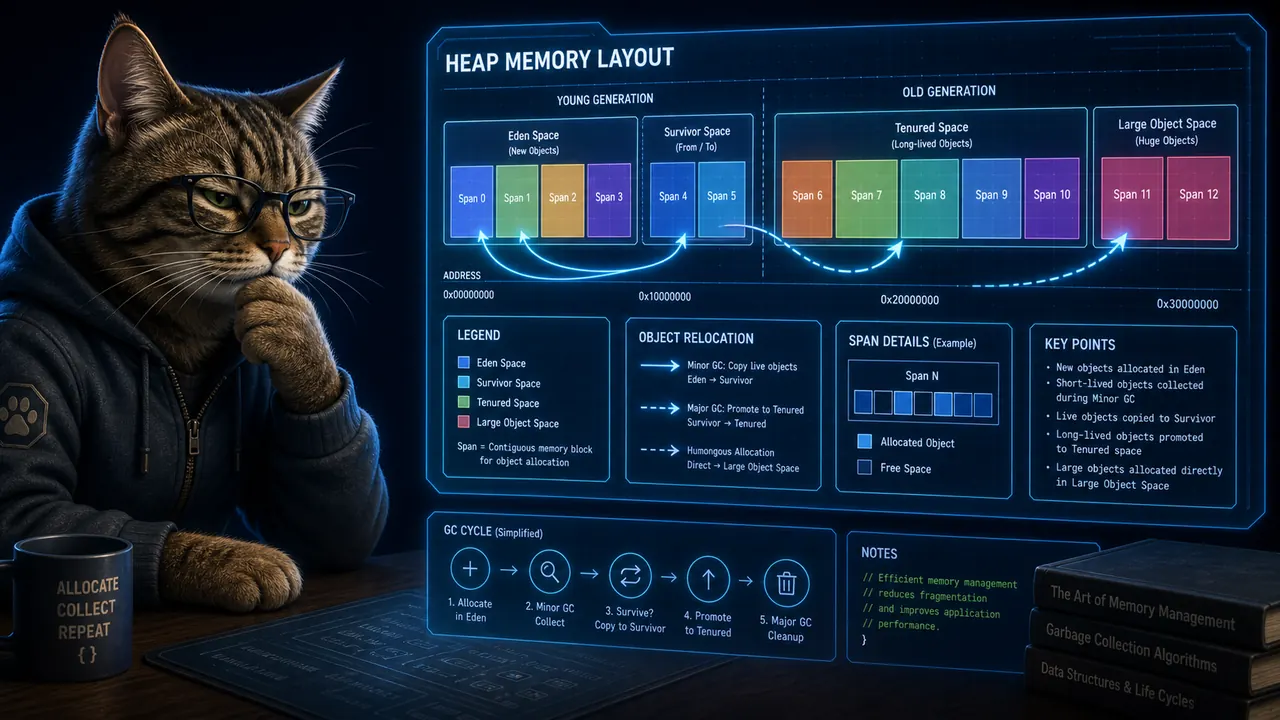
This deep dive visualizes Go's size-segregated heap allocator, where same-size objects land in contiguous 8 KiB page spans, showing in real time how the new GC can relocate objects to free entire pages pinned by a single stray allocation. The author demonstrates these mechanics live, making it intuitive to see how one held reference can pin an entire span and what the new collector does about it. The practical takeaway: understanding these patterns lets Go developers write GC-friendly code for latency-sensitive workloads.
Relevance 2/10Importance 6/10
Researchers developed CyclicFP-fmoc, an adhesive that bonds to PTFE (Teflon) and other nonstick surfaces at roughly 1.2 MPa strength, survives multiple bond-release cycles, and is completely removable with ethanol or hand sanitizer while remaining reusable after recovery. The HN comment thread went immediately to PFAS and fluorine contamination concerns, drawing comparisons to 3M's contamination history, and practical suggestions included cookware repair, sensor mounting, and maritime uses. Real-world reusability is a question mark outside lab conditions, since recovering the adhesive after a bond requires deliberate effort most users wouldn't bother with.
Relevance 3/10Importance 4/10
This article explains how virtual machines map bytecode offsets back to source code line numbers for error messages and debugger step-through, without storing a line number for every byte. Efficient runtimes like CPython, the JVM, and V8 use compressed formats such as offset-to-line-number marker pairs with binary search, or run-length encoding for repetitive ranges. It's a clearly-written implementation guide for VM and language authors that documents something every production runtime does but almost no one explains at this level.
Relevance 2/10Importance 5/10
IEEE Spectrum covers Colossus, the programmable electronic computer built at Bletchley Park that cracked Germany's Lorenz cipher machine and is now receiving formal recognition as an IEEE Milestone. Predating ENIAC, Colossus was one of the first large-scale electronic computers ever built, but its existence was classified until the 1970s, which is why it's systematically underrepresented in most computing history. Historians estimate access to high-level German strategic communications may have shortened the war by years.

 HN Briefing PM