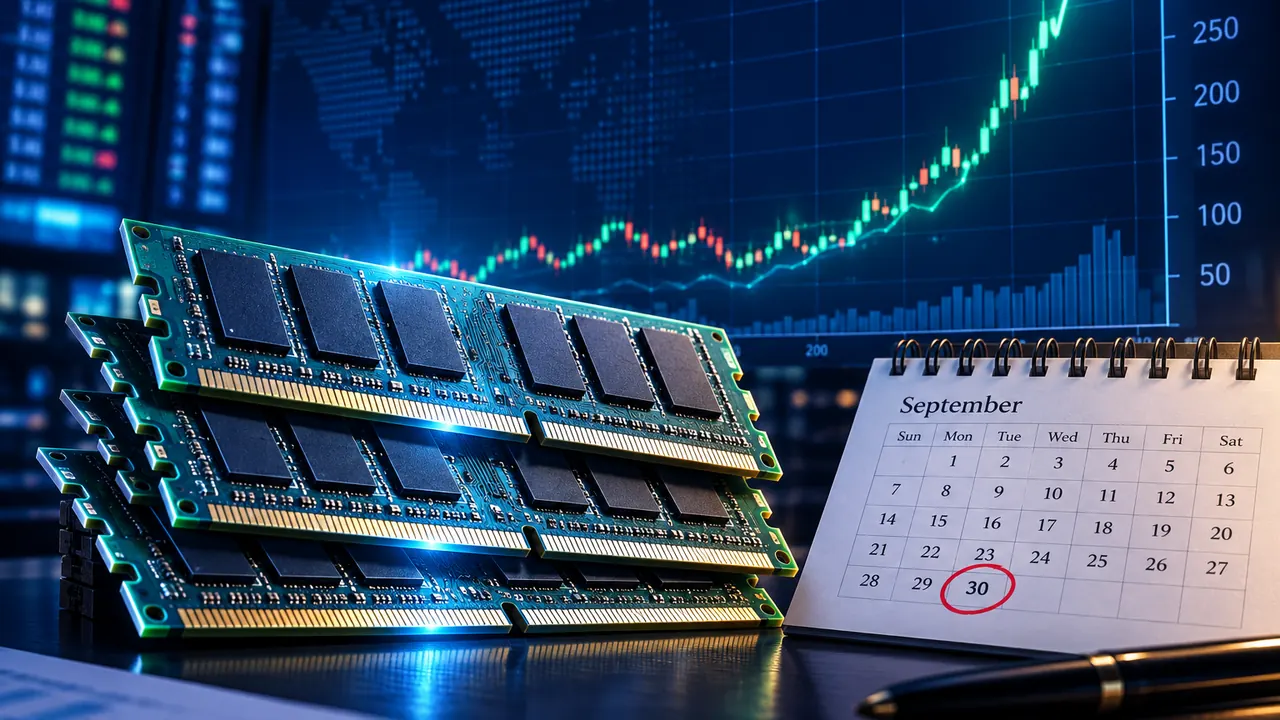
Micron is trading near $1,096 after an 18.2% weekly surge, putting the stock up 284.3% year to date and market cap near $1.24 trillion. The company guided fiscal Q4 to roughly $50 billion in revenue, about $31.00 non-GAAP EPS, and ~86% gross margin; consensus target sits at $1,515 with three firms as high as $2,000. Shares eased about 2.2% Wednesday on profit-taking — the gross-margin guide on Sept. 30 is the number that decides the argument.
KeyBanc's Justin Patterson lifted his target to $900 from $780 and Cantor Fitzgerald's Deepak Mathivanan went to $860 from $680, both Wednesday, both keeping Overweight. Muse, launched Sept. 8, cleared 500,000 users, 250,000 daily actives and 2 million prompts in week one and hit No. 1 free app on the U.S. App Store within ten days. Cantor frames personal agents as AI's "third S-curve," sizing the market above $250 billion narrowly and past $1 trillion broadly; Meta shares are up more than 20% since launch.
The Nasdaq 100 posted a record close Tuesday, then Wednesday brought profit-taking: Nvidia fell 1.5%, Broadcom 2.6%, Micron 2.2%, while credit-sensitive hyperscalers lagged harder with Alphabet down 3.8%, Oracle 3.1% and Amazon 2.2%. The PHLX semiconductor index slipped about 1% but is still up over 14% across five sessions since the Fed cut. Concentration is the caveat — half of Tuesday's SOX gain came from just four names: MU, SNDK, AMD and NVDA.
OpenAI is in early investor-led discussions at roughly a $1.2 trillion valuation, up from $852 billion in March, per WSJ reporting. Anthropic, which closed a $65 billion Series H at a $965 billion valuation in May, is being pitched by investors toward a $2 trillion valuation at an October Nasdaq listing. Neither is public today, but combined with SpaceX these three private names carry more implied value than 45 years of U.S. IPOs — and Anthropic's debut would reprice every listed AI comp.
Palantir closed up 3.68% at $191.79, with an intraday range of $182.94 to $193.79, despite the FAA awarding its $875 million SMART air-traffic contract to Air Space Intelligence. Rosenblatt's John McPeake reiterated Buy and a $225 price target, arguing Palantir keeps a broader FAA foothold through Foundry as the agency cited integration advantages. U.S. government revenue hit $809 million last quarter, up 90% year over year.
IonQ closed at $42.54, up 4.42%, after saying it ran the industry's first real-time end-to-end quantum error decoder and announced a research-center collaboration with Nvidia. Volume hit 69.9 million shares, roughly 233% above the three-month average. Real-time decoding is the gating problem for fault-tolerant quantum, so this one matters more for the roadmap than the revenue line.
Apple touched an all-time high of $345 Tuesday before closing Wednesday at $339.75, up 0.23%, leaving it roughly 25% higher year to date. The run traces to the September event — the foldable iPhone Duo, iPhone 18 Pro, Watch Series 12 and Ultra 4, and AirPods 5. Investors are also weighing a $250 million Siri-related settlement and mixed-but-firm early iPhone 18 demand, with analysts split on whether the record streak extends.
KeyBanc's John Vinh raised Broadcom to $420 from $400, staying Overweight, citing CoWoS advanced-packaging supply revisions to 190,000 wafers next year — over 160% year-over-year growth. Barclays' Simon Coles took TSMC to $355 from $330, also Overweight. CoWoS capacity has been the physical ceiling on AI accelerator shipments, so upward revisions there read through to Nvidia, AMD and the custom-silicon complex.
Goldman Sachs pegs AI-related debt issued in 2026 at roughly $489 billion, with hyperscaler issuance projected near $420 billion next year. Oracle sold $30 billion in February after $18 billion in September 2025 and ended its fiscal year with $149 billion in long-term debt, up from $96 billion. Alphabet's $80 billion equity raise priced a day later at $84.75 billion — the largest such deal for a listed corporate — and even top-rated issuers are paying up on spread.
CoreWeave had the busiest tape among AI-infrastructure names Wednesday, pairing bullish analyst calls and new customer announcements with a large convertible debt deal. The read-through is straightforward: demand for rented AI compute is still outrunning supply. The financing structure is the thing to watch, since converts add dilution risk alongside the leverage story running through story nine.

 AI Stocks