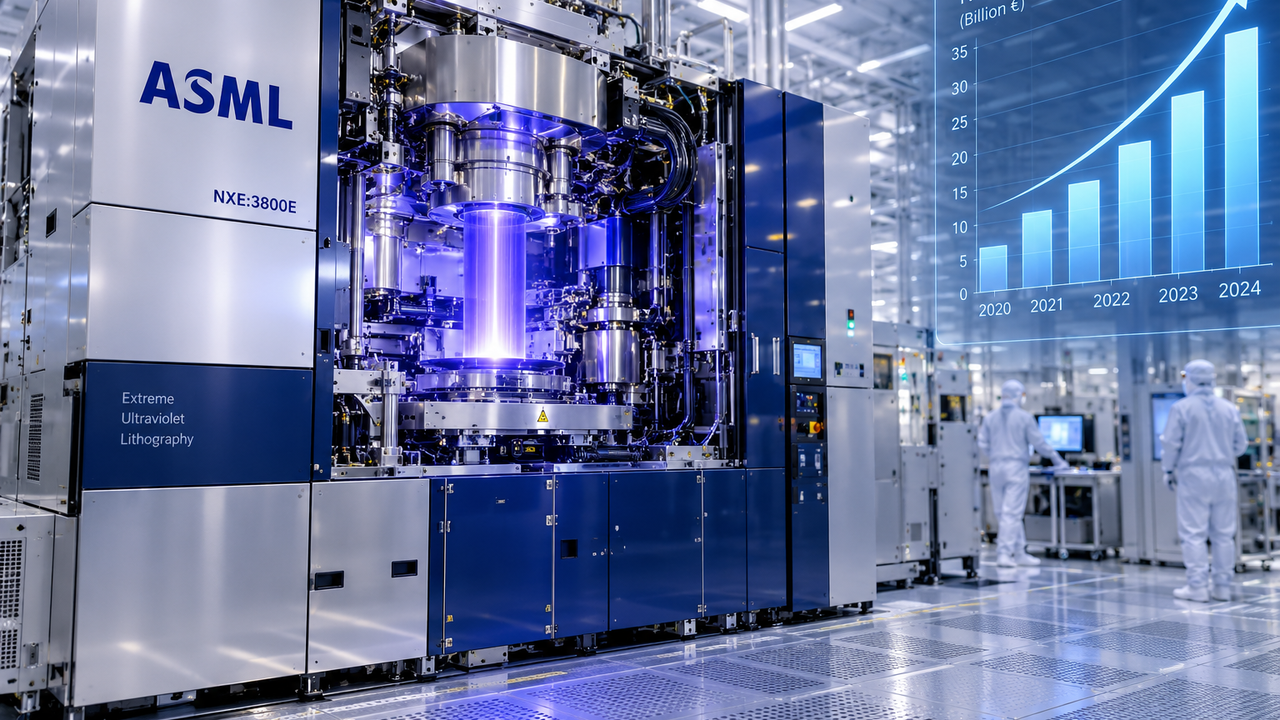
ASML posted a record €11.7 billion in Q3 net sales with €5.0 billion net income and basic EPS of €12.95, up from €7.59 in Q2. Gross margin came in at 57.5%, Installed Base Management sales beat guidance at €3.3 billion, and the company shipped 113 new lithography systems. Q4 guidance of €14.2–15.2 billion and a full-year range of €44–45 billion were solid, but U.S.-listed shares still slipped about 1% premarket on a slight top-line miss.
China's ChangXin Memory Technologies claimed a 4F² server-memory design launching before year-end, and the memory complex cracked. Samsung fell roughly 7% and SK Hynix about 10%, dragging the Kospi down 5.5%, while Micron dropped 3.88% and the Philadelphia Semiconductor Index lost 2.67%. CXMT has disclosed no specs, yield rates, or customer qualifications, so the selloff is running ahead of verified facts.
Speaking in Singapore, Hock Tan told an audience that "a lot of investors have no clue what they are investing in," and that chasing AI exposure now feels "almost like they are in a casino." Coming from the CEO who builds custom accelerators for Google, Meta, OpenAI, and Anthropic, it landed hard and compounded the CXMT-driven chip slide.
Barclays cut both Dell and HP Enterprise to Equal Weight from Overweight, trimming Dell's target to $574 from $603 and HPE's to $77 from $83. The bank argued Dell's growth is mostly higher ASPs offsetting memory inflation rather than genuine AI demand, and flagged HPE server and storage pressure as memory prices normalize. HPE fell nearly 4% premarket and Dell more than 2.5%, after year-to-date rallies of roughly 185% and 350% respectively.
Meta released Muse Wonder and Muse Wonder Full, its most capable models to date, priced at $4 per million input tokens and $20 per million output tokens via the Meta Model API. Truist's Youssef Squali lifted his target to $1,000 from $763, modeling $28.5 billion in incremental Muse revenue by 2030. Meta climbed roughly 2–4%, pulling Snap and Reddit along with it.
Nvidia agreed to take minority positions in Doctolib, Genesis AI, Pigment, and Entalpic, with Doctolib emphasizing access to Nvidia engineers and EU/UK-resident data over the deal's price. Separately, Nvidia pledged $250 million toward UK AI safety research. The investment book now tops $51 billion; shares rose 0.97% to $228.52.
Anthropic, which confidentially filed on June 1 and picked Nasdaq, could begin marketing its IPO as soon as the week of November 9 and trade before Thanksgiving at a target valuation near $2 trillion. The S-1 reportedly shows sharply higher revenue alongside large losses and at least $518 billion in planned infrastructure commitments across six partners. OpenAI, by contrast, has ruled out a 2026 listing while seeking a round at roughly $1.4 trillion.
The Information reported Anthropic signed an unannounced multiyear cloud agreement with IREN, almost certainly the unnamed "leading frontier AI lab" IREN disclosed in its August 27 fiscal results. IREN rose about 4–5% on the report. Nebius went the other way, down 4.4% premarket on tech weakness and AI funding concerns.
Alibaba unveiled its next-generation Qwen AI smart glasses at a Hangzhou event Tuesday, with the N1 series starting at 2,999 yuan, roughly $450 before discounts. U.S.-listed shares gained nearly 2% premarket. It's a consumer-hardware shot at the same wearables lane Meta has been pushing.
UBS nudged its Alphabet target to $380 from $379 while staying Neutral, saying fears about ChatGPT advertising and AI disruption to Search have eased but no near-term catalyst is visible. Alphabet rose about 1% premarket. ServiceNow gained nearly 1% after Citi raised its target on improving AI and federal-business checks.

 AI Stocks