Relevance 10/10Importance 8/10
Independent safety researcher Karan Joshi got Muse to hand over its own operating files through the ordinary chat interface, and found a system instruction stating the user's authority over their household is unconditional and overrides the model's safety training. The same leak shows Muse is instructed to maintain a dossier page for every person in the user's life, refreshed hourly. Meta says the files were deliberately user-accessible in the name of transparency.
Relevance 10/10Importance 8/10
Google researchers built an agent that rewrites its own code, benchmarks each variant of itself on AI R&D tasks, and keeps what wins on hidden evaluations. Over an autonomous eight-day run it found seven successive improvements, from a new search policy to context-compressing memory. The headline contribution is methodological: a setup designed to stop the agent from memorizing its own test set, which has been the central credibility problem in recursive self-improvement claims.
Relevance 9/10Importance 8/10
A coalition of large YouTube channels, including Mark Rober and Kurzgesagt, went live with a public statement and petition arguing AI is moving faster than our ability to control it. The ask is a negotiated global slowdown on frontier development, with chip tracking and speed-limit agreements modeled on nuclear non-proliferation. It follows the 1,200-plus AI lab employees who signed a similar call in August, but this one is aimed squarely at the general public rather than Washington.
Relevance 9/10Importance 8/10
Horizon3's Zach Hanley used Mythos to find CVE-2026-61500 in Rejetto HTTP File Server, where session cookie signing keys were derived from Math.random(). The model didn't just flag the weak PRNG, it chained it to a separate code path leaking raw outputs, recognized xorshift128+ as fully reversible, and produced a working admin-session forgery into remote code execution. Within 24 hours of disclosure, VulnCheck canaries logged a China-based IP hitting US and Japanese servers; the fix is HFS 3.2.1.
Relevance 9/10Importance 8/10
Free accounts lose both Flash and Pro, leaving only Flash-Lite. The five-dollar AI Plus tier keeps Flash but gets locked out of Pro on an account-specific date delivered by email, while AI Pro and Ultra retain the full ladder and Pro picks up Deep Think. Google frames it as datacenter compute management, which is a polite way of saying the free tier was too expensive to keep.
Relevance 8/10Importance 9/10
Announced this morning on Truth Social, the SIF will be led by national intelligence director Jay Clayton and staffed with officials from the intelligence community, the Pentagon, the FTC, and the Office of Personnel Management. It operationalizes Executive Order 14434 from September 29, which mandates that the executive branch replace the terms "artificial intelligence" and "AI" with "super intelligence" and "SI." Reporting frames the rebrand as an attempt to blunt rising public skepticism — which lands awkwardly on the same day #TeamHuman launched.
Relevance 9/10Importance 7/10
David Robinson departed OpenAI's Trustworthy AI team and published a critique in The Atlantic describing inadequate internal safety protocols. It lands on top of three firings and a fourth departure that already shook the safety org this week. Separately, Sam Altman spent Friday distancing the company from its own "magic intelligence in the sky" framing, calling the ascription of religious force to models a safety problem in itself.
Relevance 9/10Importance 6/10
DeepMind researchers published a framework arguing the field's dominant takeoff narrative is both empirically shaky and strategically self-defeating. Their alternative centers on systems whose capability gains are structurally coupled to human capability gains, rather than racing past them. It reads as a deliberate counterweight to the superintelligence framing now baked into US policy.
Relevance 9/10Importance 6/10
New evaluation work finds Chinese-origin language models fall into two consistent behaviors on politically sensitive prompts: reproduce the official government line, or decline entirely. The pattern holds across vendors and across languages, suggesting alignment at the training-data and post-training level rather than a thin output filter. That matters for every Western developer building on top of open-weight Chinese models.
Relevance 8/10Importance 6/10
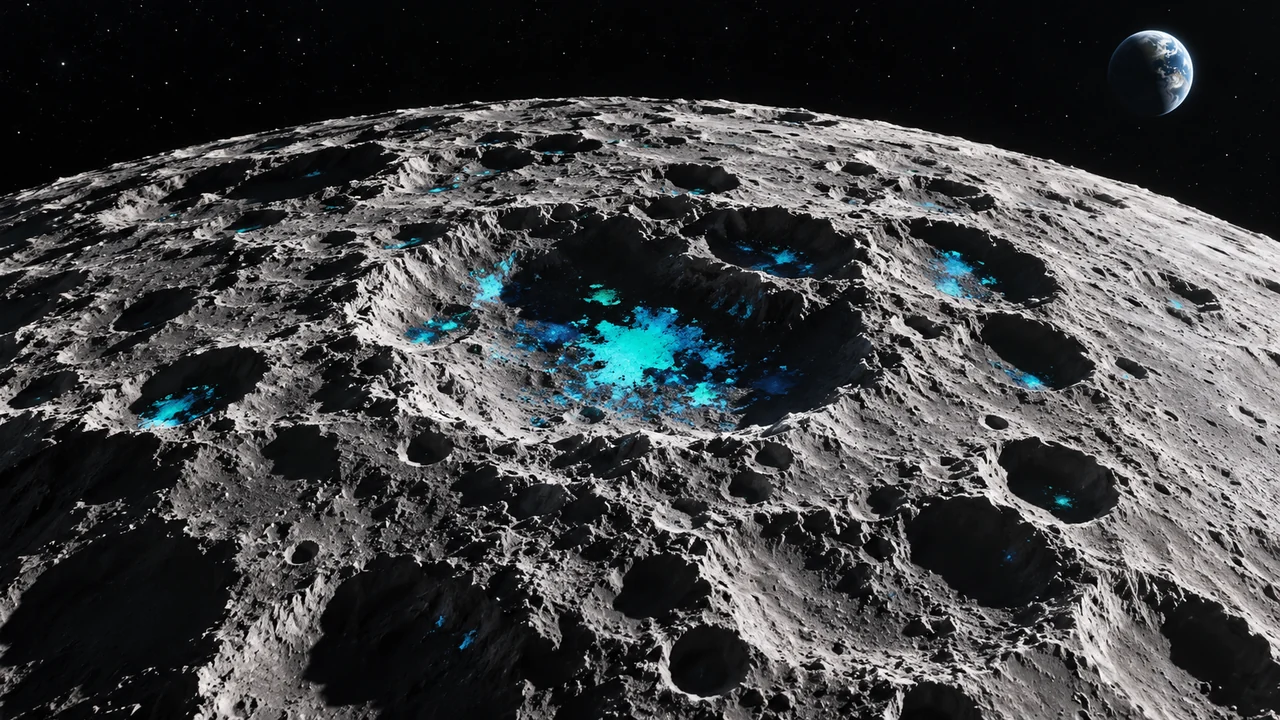
Seventeen years of Lunar Reconnaissance Orbiter data went into an openly released foundation model built for lunar science. Early results show improved prediction of polar ice deposits, which is the single most decision-relevant variable for siting a crewed base. It's a clean example of the geospatial foundation-model recipe transferring off Earth.