Relevance 10/10Importance 9/10
Anthropic has written to the White House accusing Alibaba and its AI lab of carrying out what it calls the largest known "distillation attack" against its models to date. According to Anthropic, operators ran roughly 28.8 million exchanges through about 25,000 fraudulent accounts between April 22 and June 5, using adversarial distillation to harvest Claude's reasoning patterns. The technique lets competitors mimic a frontier model's behavior while skipping much of the R&D cost; Alibaba had not responded to requests for comment.
Relevance 9/10Importance 6/10
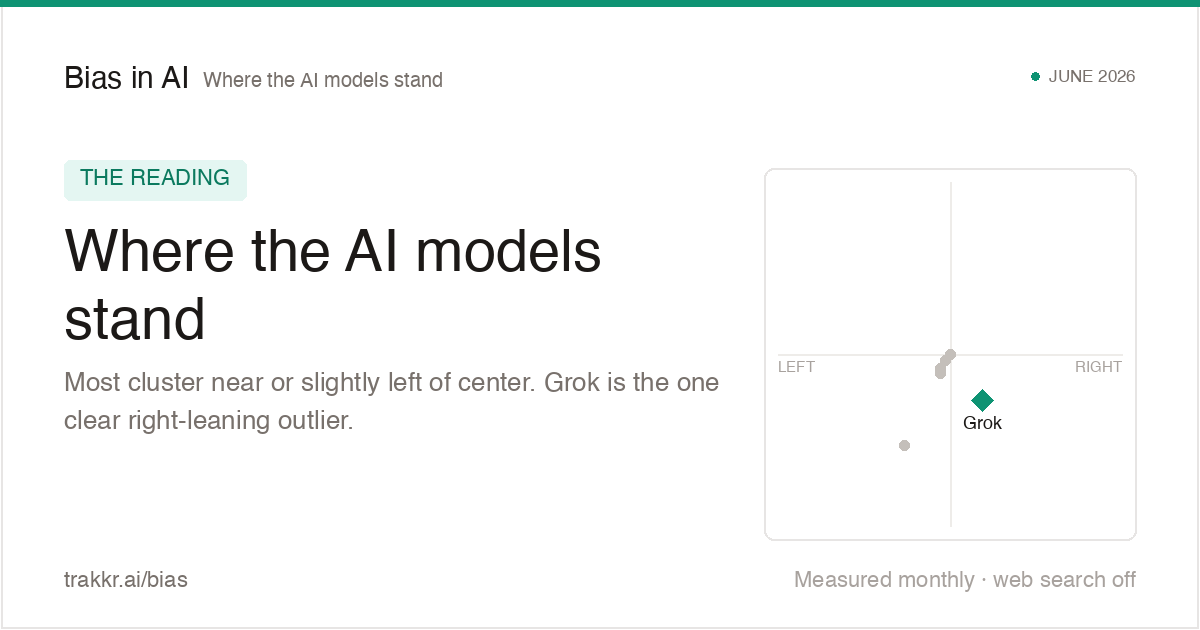
A new interactive from trakkr.ai maps major language models onto economic and social political axes by feeding them identical questions on divisive topics like drug legalization, wealth taxation, and hate-speech rules. The finding: four of six models lean left of center, with Grok sitting furthest right and Gemini closest to the center. It's a sharp reminder that model alignment choices show up as measurable political tilt.
Relevance 8/10Importance 6/10
EPFL researchers Martinelli, Brea, and Gerstner argue the popular "lottery ticket" explanation for why big neural networks train well is intuitive but misleading, since winning subnetworks can be broken by perturbing the rest of the net. Instead, they propose a loss-landscape-geometry view in which extra width expands the set of available escape dimensions for gradient descent. It's a reframing of one of deep learning's most-cited intuitions.
Relevance 7/10Importance 7/10
Cloudflare opened self-managed OAuth to all developers, letting them create and manage their own OAuth clients for delegated API access to build SaaS integrations, internal platforms, and agentic tools. It rode on a zero-downtime migration of its OAuth engine from Ory Hydra 1.x to 2.x serving live production traffic, which cut API P95 latency by 45% and CPU usage by 37% while tightening security controls. It's a meaningful unlock for anyone wiring agents into Cloudflare's stack — and a clean case study in swapping auth infrastructure under load.
Relevance 7/10Importance 4/10
LingoChunk is a Show HN language-learning tool that takes native-speaker audio and converts it into flashcards plus shadowing-practice drills, where learners repeat after the speaker to build fluency. It's aimed at turning real listening material into structured, repeatable study chunks. A tidy example of an indie AI-flavored learning startup launching straight to the HN crowd.
Relevance 6/10Importance 5/10
This essay argues that the hardest parts of building good software, judgment, polish, and a sense of when something just feels right, can't be captured by automated tests. The author makes the case that taste is a human discipline that tooling can support but never replace, a theme that lands harder in an era of AI-generated code. It's a thoughtful counterweight to "just let the model write it."
Relevance 4/10Importance 7/10
LastPass told users that a breach at third-party vendor Klue, a market-research firm, exposed customer names, phone numbers, email and physical addresses, and support-case data. The company says encrypted password vaults were not affected, but warned users to brace for phishing and shared IPs and email domains tied to the attackers. For a password manager, "yet another" is not a phrase that inspires confidence.
Relevance 4/10Importance 6/10
A pair of developers, slqnt and 98006, ported Half-Life 2 to run directly in the browser in about three months, with the game downloading and storing assets locally (the largest file around 12MB). Facial animations are disabled for performance and crouch is rebound to C, but it's fully playable in Chrome and Firefox, glitches and all. Episodes 1 and 2 are on the roadmap.
Relevance 3/10Importance 5/10
An Economist 1843 investigation finds that despite anime's global boom, Japan's animation industry is in crisis, with grueling labor conditions and brutal pay driving artists away. The piece warns that if structural pressures continue, the talent pipeline behind one of the world's most popular art forms could erode. It's a cautionary look at a creative industry whose success masks its fragility.

 HN Briefing AM