Relevance 9/10Importance 7/10
A practitioner walks through co-hosting two Qwen3 checkpoints — an 80B reasoning model and a 4B fast model — on a single DGX Spark workstation with ~120 GiB of unified memory, served via vLLM. The key gotcha: vLLM's gpu_memory_utilization is a fraction of total memory, not free memory, so stacking models requires measuring actual residency with nvidia-smi rather than trusting the math. It's a tidy, hands-on guide for anyone trying to squeeze multiple local models onto one box.
Relevance 7/10Importance 7/10
The author argues that ATProto's decentralized identifiers only feel portable, because your Personal Data Server operator actually holds your signing and rotation keys. That means a PDS operator could impersonate you across every ATProto app, post as you, or lock you out entirely. The takeaway: the whole system's security rests on trusting your PDS operator, which makes the much-touted decentralization more brittle than it looks.
Relevance 6/10Importance 7/10
A new Debian package, pve-microvm, makes QEMU's microvm machine type a first-class managed guest in Proxmox, complete with a 12MB custom kernel and a 1MB initrd that boots in roughly 150 milliseconds. It adds tooling to build root filesystems from OCI base images, import OCI images straight into PVE disks, and even a "Create µVM" button in the web UI. The author built it because they were tired of choosing between lightweight LXC containers and heavy full VMs, especially for fast-booting CI workers.
Relevance 5/10Importance 8/10
For the first time, Google's measurements show IPv6 traffic reaching 50% of its users, a landmark for the decades-long migration. It signals that IPv6 is now a fully mature, globally deployed protocol operating at massive scale across both fixed and mobile networks. The flip side: it confirms we're settling into a long-term two-protocol world, with all the dual-stack complexity that entails.
Relevance 6/10Importance 6/10
The revived Commodore brand is back with the Callback 8020, a Sailfish OS flip phone it bills as "the not dumb dumbphone," with T9 texting, no social media, no email, and notably no AI baked in. It still runs friendly apps like Maps, Spotify, WhatsApp, and Uber, and can sideload supported Android apps if you need more. Pricing starts at $500 up to a $640 gold Founders Edition, with pre-orders opening June 30 and shipping in Q4 2026.
Relevance 4/10Importance 7/10
Beyond All Reason is a free real-time strategy game inspired by Total Annihilation, built on the open-source Recoil Engine and featuring thousands of units, simulated projectile ballistics, explosion physics, and terrain deformation. It runs on Windows and Linux with active community development and regular balance updates, now backed by publisher Hooded Horse. It's a strong showcase of what a sustained open-source game project can become.
Relevance 5/10Importance 4/10
This experimental project pairs Dyalog APL with SDL3 to build a 3D voxel engine, purely as a challenge to see whether APL's dense array notation could simplify graphics work. APL was never designed for real-time 3D, which is exactly what makes the result interesting. It's a proof that the language's array-processing strengths can stretch into interactive graphics territory.
Relevance 5/10Importance 4/10
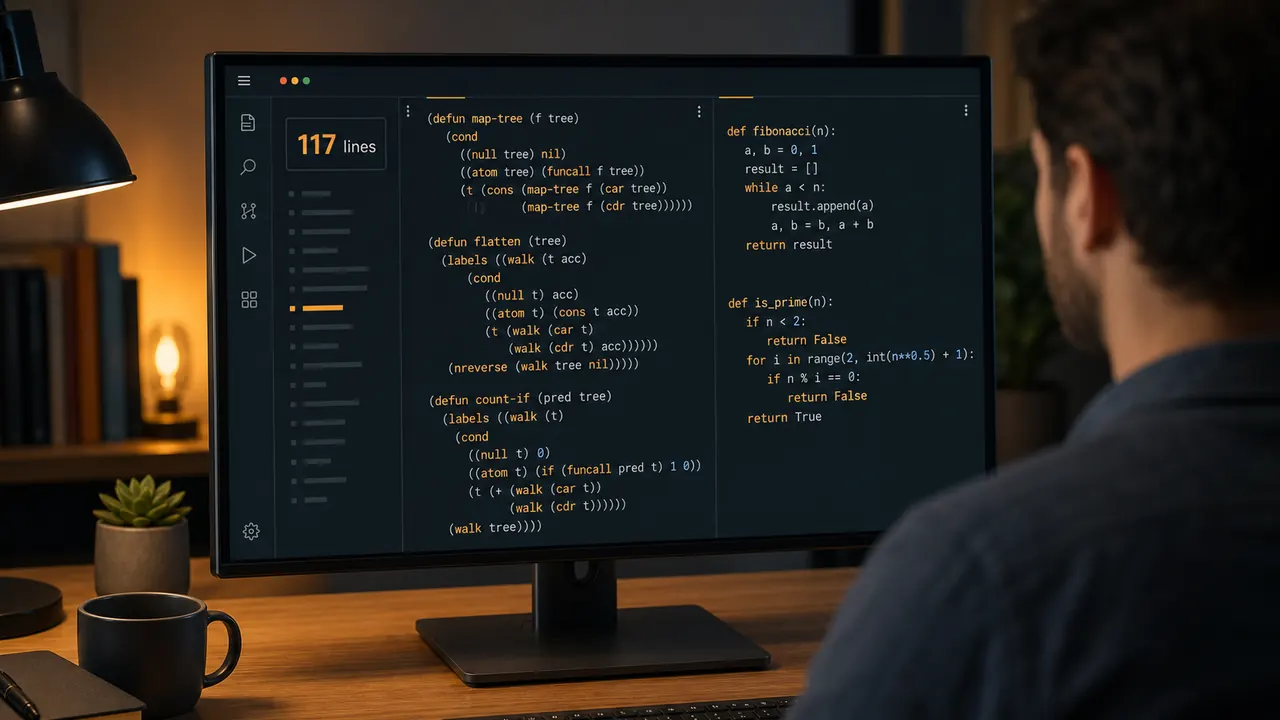
Peter Norvig's classic tutorial builds a working Lisp interpreter in just 117 lines of Python, split into a parser that produces an abstract syntax tree and an evaluator that runs it. It demonstrates how a tiny set of expression-forming rules can yield a practical, efficient language, progressing from a calculator to full procedures, lexical scoping, and recursion. It remains a canonical lesson in interpreter design that's resurfaced on the front page.
Relevance 4/10Importance 3/10
This repository converts the classic games from David Ahl's "BASIC Computer Games" — originally GW-BASIC from Creative Computing — into C so they compile and run on Linux, Windows, and FreeDOS. Notably, the author used an AI coding tool to translate the programs from BASIC to C, keeping the original BASIC alongside for reference. It's a fun blend of retro computing nostalgia and modern AI-assisted porting.
Relevance 3/10Importance 4/10
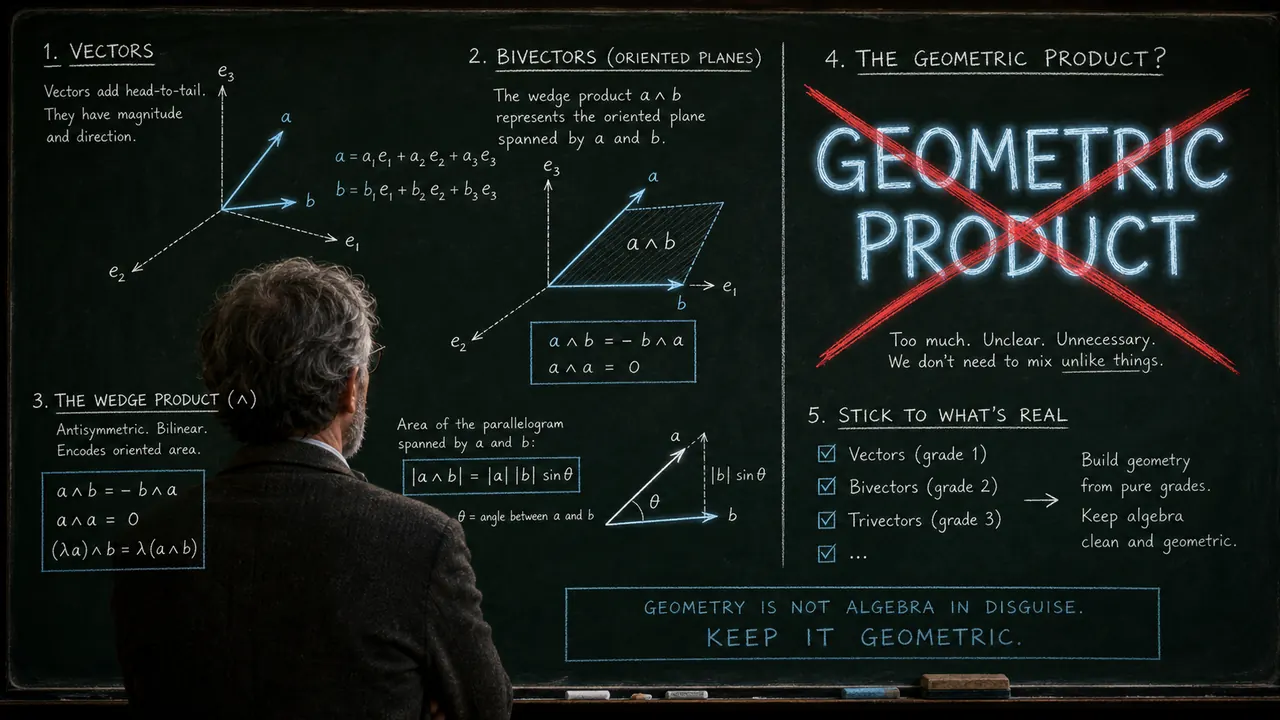
The author argues that while exterior-algebra ideas are genuinely useful, the celebrated "geometric product" lacks real geometric meaning and muddles vectors with operators. They contend GA needs a pile of confusing auxiliary operations and ends up treating an implementation detail — Clifford algebras for operator composition — as if it were the foundation of geometry. Rather than reforming math as promised, they say, it adds confusion.

 HN Briefing AM