Relevance 10/10Importance 8/10
Sakana AI unveiled Fugu, a multi-agent system delivered as a single API that dynamically assembles, routes, and coordinates specialized expert models to tackle complex multi-step tasks. Built on two research papers, TRINITY and the Conductor, it learns model orchestration through dynamic role assignment and natural-language coordination, claiming frontier-level performance on reasoning, coding, and science benchmarks while cutting cost and complexity.
Relevance 10/10Importance 8/10
Apertus is a fully open foundation model from EPFL, ETH Zurich, and CSCS via the Swiss AI Initiative, shipping open weights, open data, and open science with documented training and alignment. It comes in 8B and 70B sizes, supports over 1,000 languages, and is built to comply with EU AI Act requirements.
Relevance 9/10Importance 7/10
The author argues the gap between proprietary models like Claude and GPT and open alternatives has narrowed enough that switching carries little real cost. While open models still trail on leaderboards and raise privacy questions over third-party APIs, running them locally is increasingly viable, and the author frames any productivity hit as short-term, more like swapping Linux for Windows than a true downgrade.
Relevance 9/10Importance 6/10
The author fine-tuned Qwen 3's tiny 0.6B model to categorize household questions for a RAG chatbot, starting from roughly 10% accuracy with prompting alone. A first fine-tuning pass hit 79%, and a second iteration using fixed, non-overlapping output codes instead of category names pushed it to 92% across 131 test cases.
Relevance 6/10Importance 7/10
A software engineer recounts working at GenieDB, a UK startup acquired by a fund run by VC Stuart Frost. Years later they learned Frost was sued by the SEC over excessive incubator fees charged to portfolio companies, and internal emails suggested GenieDB may have been kept alive mainly to generate those fees, leaving the author wondering whether their early career was propped up by a scheme.
Relevance 6/10Importance 6/10
Deno Desktop converts Deno projects into self-contained desktop apps by bundling your code, the runtime, and a web rendering engine into redistributable per-platform binaries. It can turn anything from a single TypeScript file to a full Next.js or Astro app into a native application, keeping npm access plus features like auto-updates, native dialogs, and cross-platform compilation.
Relevance 4/10Importance 7/10
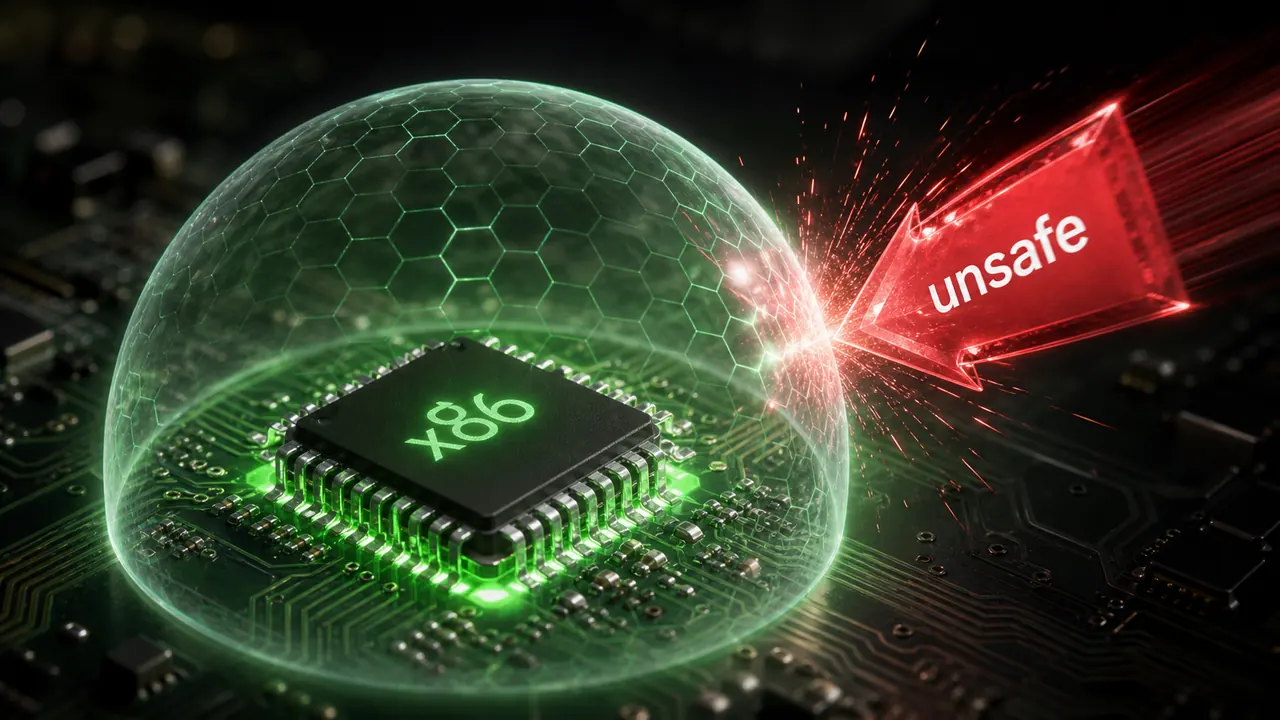
Fil-C now lets developers write x86-64 inline assembly while preserving full memory safety by parsing instructions and constraints at compile time. It rejects anything that touches memory, alters control flow, or has unspecified side effects, and the project bills it as the first-ever implementation of memory-safe x86-64 inline assembly.
Relevance 3/10Importance 7/10
Danish anarcho-capitalist activist and former police officer Lars Kragh Andersen had his Copenhagen apartment raided by masked officers after he posted his "two favourite numbers," which turned out to be the social security and phone numbers of Prime Minister Mette Frederiksen. The case has become a flashpoint in debates over free expression and state overreach in Denmark.
Relevance 2/10Importance 5/10
This essay argues that logarithms, viewed as isomorphisms between multiplicative and additive structures, show up throughout mathematics in disguise. The author shows how vector projections, linear-algebra dimensions, p-adic valuations, and derivatives are all instances of the same logarithmic operation, suggesting math often misses this underlying unity.
Relevance 3/10Importance 3/10
A wigglegram is a stereoscopic image that loops slightly offset frames into a GIF for a 3D effect. The author realized they'd unknowingly shot hundreds of near-duplicate angles over the years, then wrote a perceptual-hashing script to find those pairs in their photo library and stitch them automatically into wigglegrams.

 HN Briefing PM