Relevance 5/10Importance 7/10
Virginia Governor Abigail Spanberger signed S.B. 388 in April, banning the sale of geolocation data under the VCDPA, and it took effect July 1 — making this immediately live. Virginia joins Maryland and Oregon, following FTC enforcement action against data brokers and the California AG's 2025 investigation into the location data industry. For any startup monetizing location signals, the regulatory floor is rising fast and multiple additional states have similar bills in motion.
Relevance 6/10Importance 6/10
The DBOS team argues that durable workflow state should live inside the same Postgres database as your application data, not in a separate workflow engine. Co-location lets you checkpoint workflow steps and update application data in a single atomic transaction, delivering true exactly-once semantics without complex idempotency bookkeeping. It's a compelling architectural argument for startups building on Postgres who want resilient workflows without adding another distributed system to their stack.
Relevance 5/10Importance 6/10
The Electronic Frontier Foundation has filed a formal letter urging the FTC to enforce the existing consent order against X, citing X's use of user data to train its Grok AI without adequate disclosure. The letter connects X's pattern of behavior — a 2011 FTC settlement, 2022 deceptive advertising charges, and now Grok — and notes the EU and UK regulators have already moved. This is the AI training data consent debate landing squarely on a US regulator's desk.
Relevance 3/10Importance 8/10
Since Linux 6.9 in May 2024, a code refactoring silently broke the tool that clears LUKS full-disk-encryption keys from RAM on laptop suspend, meaning encryption keys have been sitting in memory for over two years on affected systems. The culprit was a well-intentioned cleanup with an unexpected long-range interaction with the crypto layer. The fix is one line long, a regression test has been added, and the incident is a vivid reminder of how hard security invariants are to maintain across a large codebase.
Relevance 3/10Importance 7/10
LMDB, the embedded key-value store powering OpenLDAP, Bitcoin Core, and a long list of high-performance infrastructure, has reached version 1.0. The library achieves exceptional read performance via memory-mapped files and zero-copy semantics, and has been in serious production use for well over a decade. This milestone officially marks stability for a piece of infrastructure that's been quietly underpinning systems for years without a 1.0 label.
Relevance 4/10Importance 5/10
Podman 6.0 replaces slirp4netns and iptables with Netavark, Pasta, and nftables for networking, adds multi-provider machine support with a new OS update command, expands Quadlet with REST API capabilities and expanded volume unit features, and continues improving Docker API compatibility. It's a significant modernization of the rootless container stack and a meaningful upgrade for teams that want Docker-compatible tooling without the Docker daemon.
Relevance 3/10Importance 4/10
PeerTube's GitHub repo surfaced on HN today, spotlighting Framasoft's federated, ActivityPub-based YouTube alternative. Built with WebRTC-powered P2P streaming, it lets creators host on any instance while remaining discoverable across the Fediverse, with no algorithmic recommendations or data mining. At nearly 15,000 stars and 16,000 commits it's a mature project, and the renewed HN attention likely reflects ongoing appetite for decentralized video in an era of contentious platform moderation.
Relevance 2/10Importance 3/10
A developer has successfully built Mesa's Lavapipe software Vulkan driver on NetBSD 10.1 amd64, with full automation scripts and documentation for reproducibility. The driver installs and registers correctly, though the Vulkan loader itself still needs porting before you can run real Vulkan applications end-to-end. It's a beta milestone, but the methodical groundwork here is exactly the kind of yak-shaving that keeps niche platforms relevant.
Relevance 2/10Importance 3/10
An NUS computer science student interning at Elicit has written a practical guide to cold-ask etiquette: lead with proof of work, keep the request ruthlessly brief, make it bounded and specific, and always make it easy for someone to say no. The core framing — put yourself in their mind — is simple and the advice is actionable for anyone navigating cold networking in tech, whether as a founder, a job seeker, or a researcher.
Relevance 2/10Importance 2/10
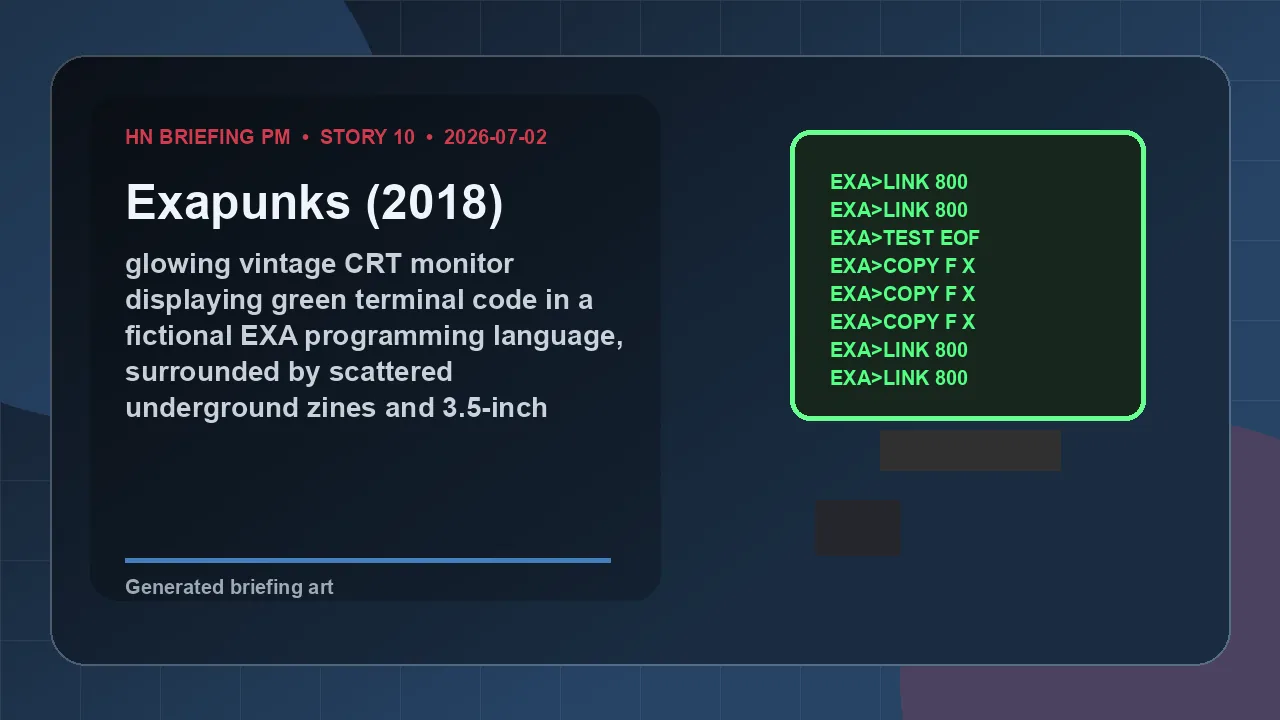
Zachtronics' 2018 hacking puzzle game is making rounds on HN again. Set in an alternate 1997, players program EXAs -- execution agents -- to infiltrate banks, government systems, and TV stations while learning through an in-game underground zine called Trash World News. It's dense, rewarding, and a cult classic among the kind of people who browse Hacker News on a Thursday afternoon.

 HN Briefing PM