Meta jumped roughly 10% to $619 after Bloomberg reported the company is building a cloud infrastructure business to monetize excess AI computing capacity, putting it in direct competition with AWS, Azure, and Google Cloud. The move reframes Meta's $145 billion capex program as a potential revenue engine rather than a pure cost center. The collateral damage was immediate: CoreWeave fell nearly 14% and Nebius Group dropped 17% on the same session.
Palantir surged 9% to $127.31 after announcing a sovereign-AI partnership with NVIDIA, with CEO Alex Karp claiming the platform beats OpenAI and Anthropic on customer IP protection. The company is posting 85% year-over-year revenue growth, though PLTR remains down 28.5% year-to-date despite Tuesday's spike. Palo Alto Networks caught the tailwind as well, gaining 4% to $355.40.
Anthropic filed its draft S-1 following a $65 billion Series H round at a $965 billion post-money valuation, holding a 31.4% global LLM revenue share in Q1 2026, just ahead of OpenAI's 29%. Amazon has deployed $13 billion in equity and Alphabet holds a 14% stake. Prediction markets favor a fall 2026 IPO — not yet publicly traded, but clearly moving the board.
OpenAI filed a confidential S-1 on June 9 targeting a roughly $1 trillion valuation, approximately 50x its $20 billion annualized revenue run rate. Sam Altman has been vague on timing, with prediction markets split between late 2026 and early 2027. Amazon and Google have collectively committed over $70 billion in equity and cloud obligations.
Broadcom secured two consecutive custom AI chip orders from Anthropic worth $10 billion and $11 billion respectively, layered on top of existing custom silicon work for Alphabet and Meta. Wall Street now projects 66% revenue growth for Broadcom in 2026 driven by AI accelerator demand. Custom silicon is clearly becoming AVGO's defining growth engine.
Intel dropped 8.32% on Tuesday as analysts warned that massive AI infrastructure commitments by cloud giants are structurally squeezing Intel's traditional data center chip sales. The core argument: when hyperscalers lock up capex for custom silicon and GPUs, Intel's server products lose procurement budget. No near-term catalyst was identified by the flagging analysts.
CrowdStrike's 4-for-1 stock split takes effect today, July 2, with split-adjusted shares beginning to trade this morning. Pre-split shares were up roughly 2% at $776 ahead of the event. The split is designed to broaden retail access to what has been one of 2026's standout cybersecurity AI plays.
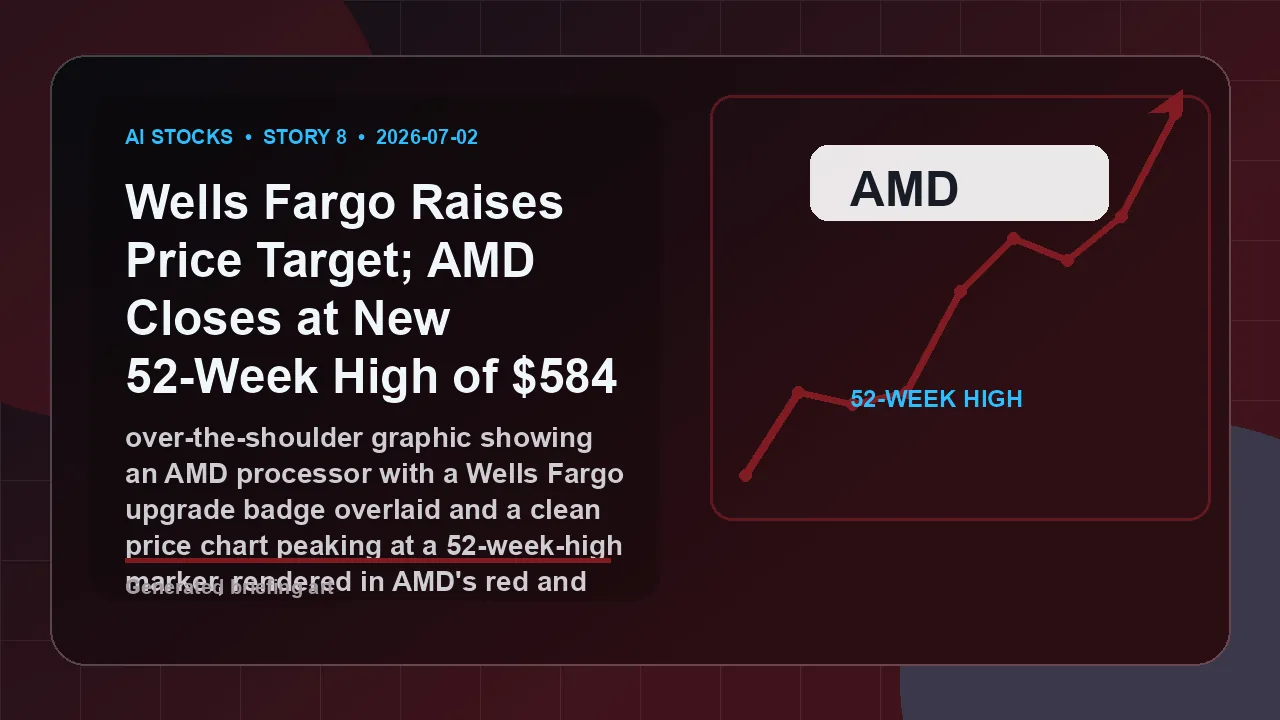
Wells Fargo analyst Aaron Rakers raised his AMD price target, maintaining Overweight on the back of accelerating server CPU demand from agentic AI workloads. AMD closed at a fresh 52-week high of $584, up 7.68% in Tuesday's session, and is up 156% year-to-date. A mid-June acquisition of memory optimization firm MEXT also contributed a 7% single-day spike earlier in the month.
NVIDIA's Palantir partnership deepens its government AI reach, yet the stock has notably lagged the broader semiconductor index's 94% 2026 gain. Sixty-two analysts carry an average 12-month price target of $298.93, implying roughly 49% upside from current levels on a Strong Buy consensus. The relative underperformance is a quiet subplot the market hasn't fully resolved.
IonQ reported Q1 2026 revenue of $64.7 million, a 755% year-over-year surge, backed by a $3.1 billion cash position. The quantum computing firm is up more than 60% year-to-date and remains one of the higher-volatility breakout names in AI-adjacent tech. The bear case is sustained cash burn and no clear near-term path to profitability.

 AI Stocks