Relevance 10/10Importance 8/10
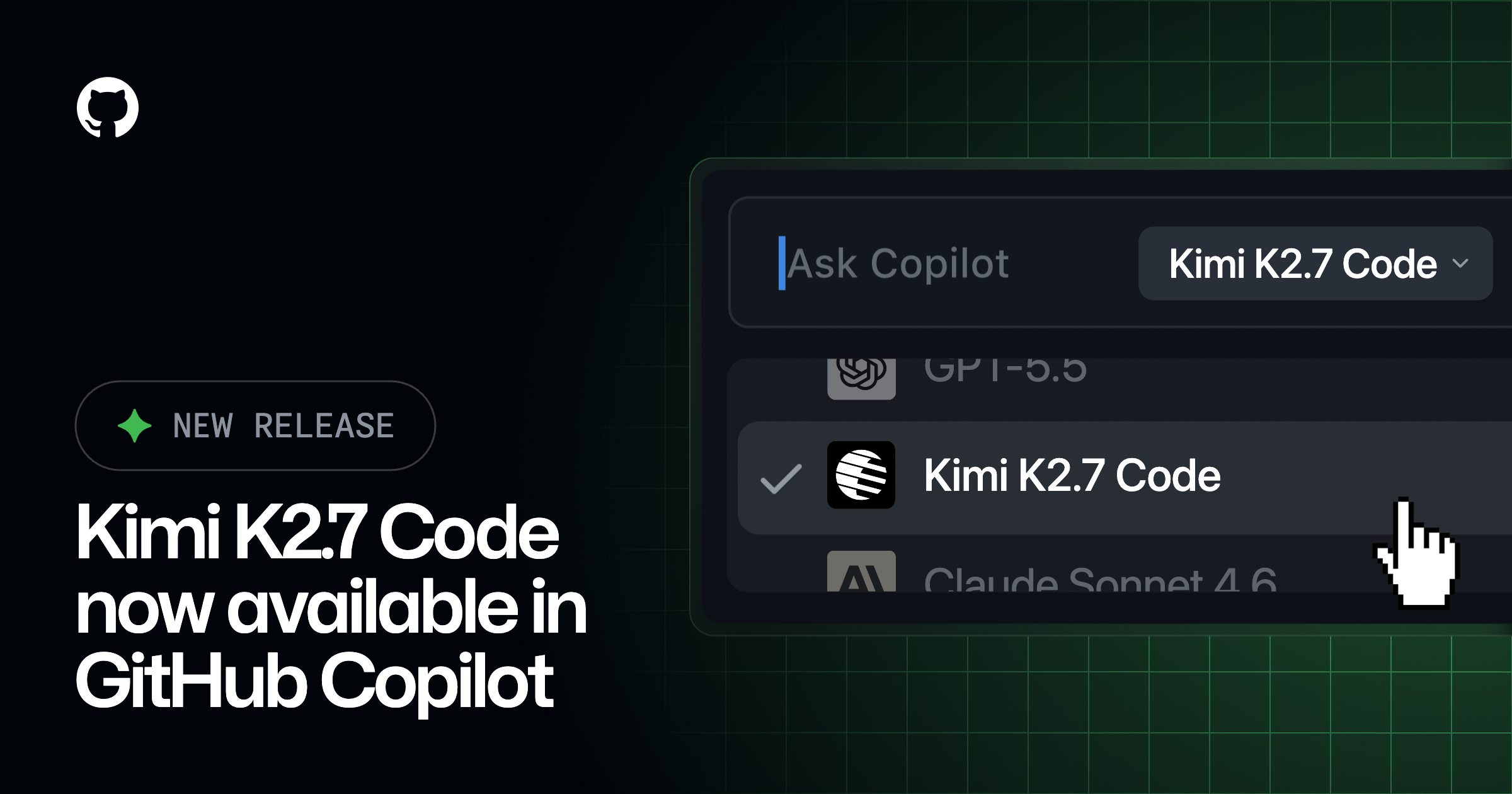
Moonshot AI's Kimi K2.7 Code becomes the first open-weight model selectable in GitHub Copilot's model picker, hosted on Microsoft Azure at provider list pricing. It's rolling out now to Pro, Pro+, and Max tiers across VS Code, JetBrains, Xcode, and more — but Business and Enterprise orgs must explicitly enable it via admin policy. This marks a notable shift in Copilot's model strategy, opening the picker to non-Microsoft and non-OpenAI options.
Relevance 10/10Importance 8/10
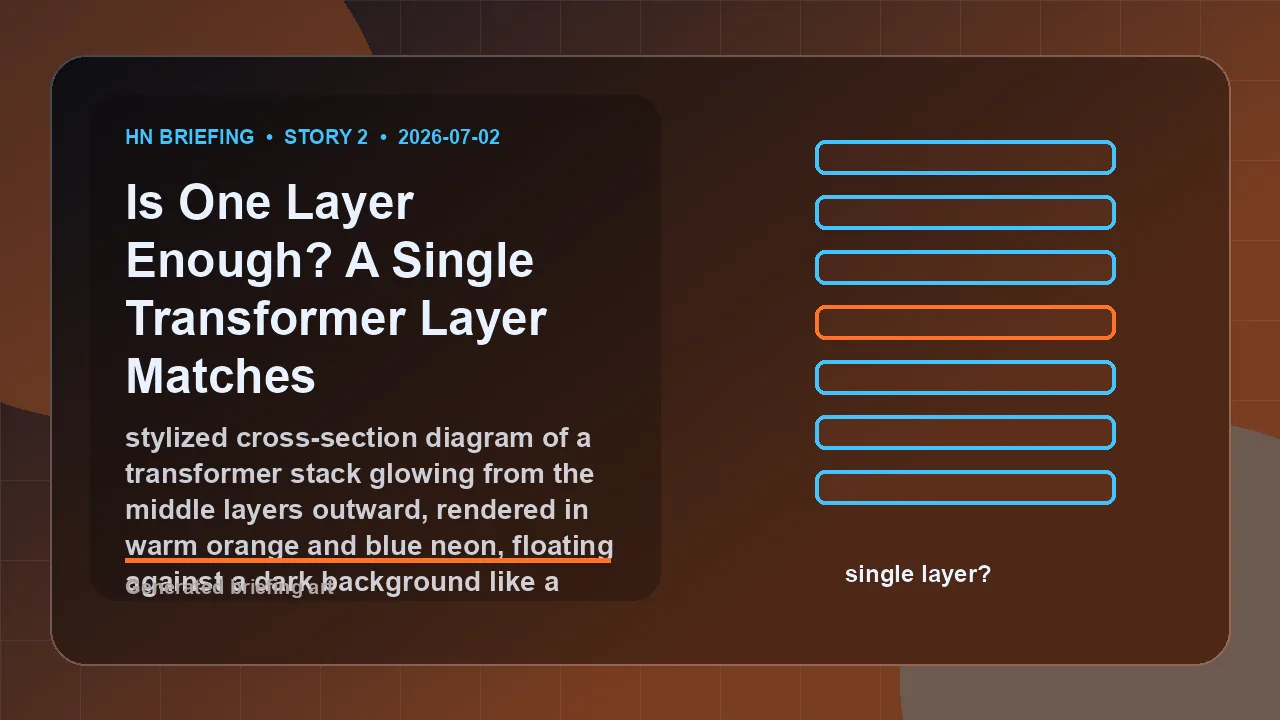
Researchers introduce a "layer contribution" metric and find that training just one transformer layer can recover most — and sometimes all — of the gains from full-parameter RL fine-tuning. High-contribution layers cluster in the middle of the stack, not near the input or output ends, and this pattern holds across seven Qwen-family models, three RL algorithms (GRPO, GiGPO, Dr. GRPO), and tasks from math reasoning to code generation. If this holds up at scale, it could dramatically reduce the compute cost of post-training RL.
Relevance 9/10Importance 7/10
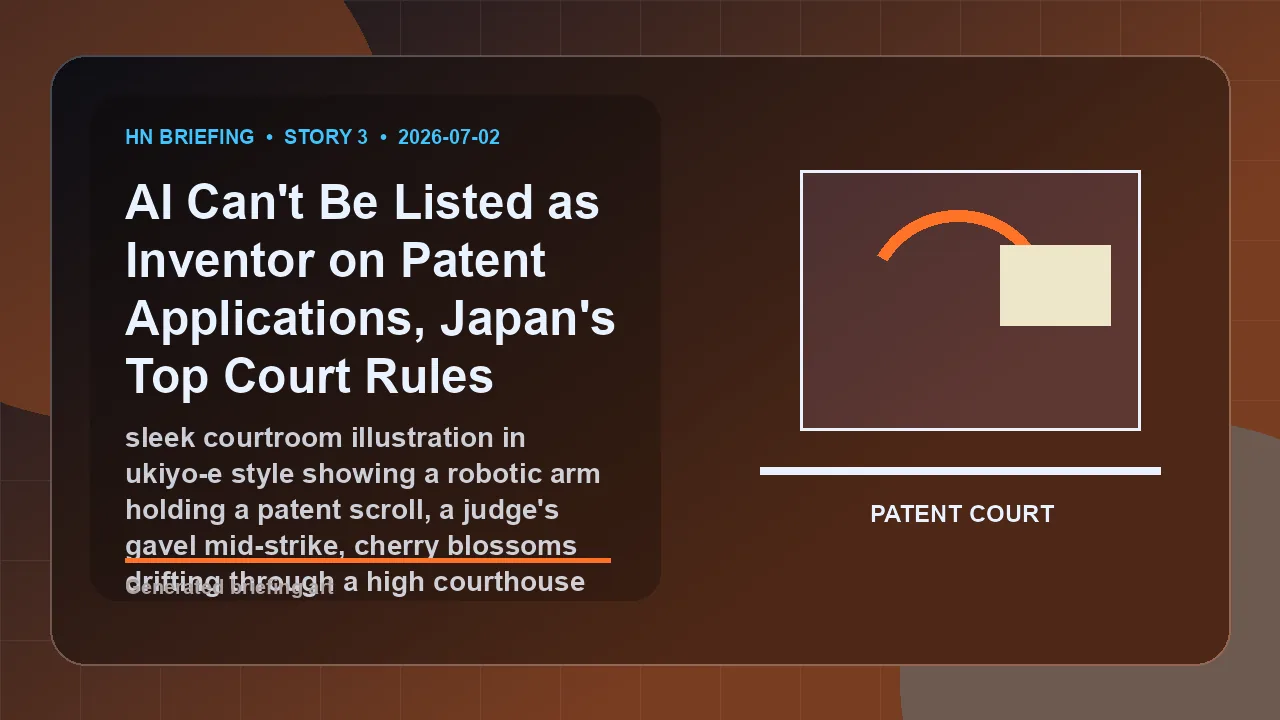
Japan's Supreme Court has ruled that AI systems cannot be named as inventors on patent applications, aligning the country with the US and EU on the question of AI inventorship. The ruling reinforces that inventorship requires a human, leaving open — but unresolved — the thornier question of how AI-assisted inventions should be credited and protected. For AI startups building on proprietary models, the IP landscape remains murky but is now consistently human-first across major jurisdictions.
Relevance 6/10Importance 8/10
F-Droid is sounding the alarm over Google's Android Developer Verification program — a system service with root privileges already on roughly four billion devices that will block app installs from unapproved developers starting September 30 in four countries. The critical vulnerability: Google's own terms of service never formally define "malware," giving the company unilateral discretion to designate any software it dislikes as harmful — a concern with precedent, since ad blockers were previously banned from the Play Store. Over 70 organizations including the EFF and FSF have signed an open letter opposing the program.
Relevance 8/10Importance 5/10
Slopo is a Python CLI tool that finds semantically similar code — not just copy-paste duplication — by computing embeddings via any LiteLLM-compatible provider and clustering results by cosine similarity. It supports eight languages including Python, TypeScript, Go, and Rust, and is explicitly designed to feed candidate pairs to AI agents for verification and refactoring decisions. Install with uv tool install slopo; results include codebase-distance scoring so you see the duplicates least likely to have been caught already.
Relevance 7/10Importance 6/10
ZeroFS mounts S3-compatible buckets as POSIX filesystems over NFS, 9P, or as raw block devices via NBD, using a log-structured write engine with immutable objects and compaction. The system layers always-on XChaCha20-Poly1305 encryption, zstd/lz4 compression, geo-distribution across S3 regions, and automatic failover — and passes 8,662 POSIX suite tests in CI. Warm-cache read latency hits 1.6 microseconds; small-write latency averages 0.83 milliseconds.
Relevance 8/10Importance 5/10
Hazel, a YC W24 startup building AI-powered procurement automation for federal and state agencies, is hiring a full-stack engineer for its largest U.S. government contract — a role requiring TS/SCI clearance with full-scope polygraph. The stack is AWS, Python, TypeScript, React/Next.js, and PostgreSQL; comp is $150K–$200K base plus 0.25–0.75% equity. The company frames its market as a $2.7 trillion annual procurement problem, putting AI squarely in the government contracting space.
Relevance 6/10Importance 4/10
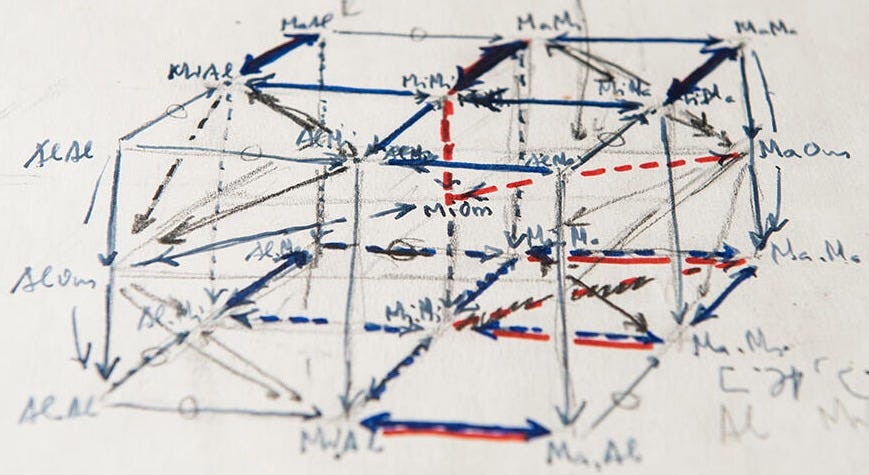
Mathematician David Bessis uses his own unpublished theorems as a springboard to argue that academia has badly misrepresented what mathematics actually is — prioritizing theorem production over the deeper conceptual work of intuition and intelligibility. He contends that AI's rapid advances in formal problem-solving expose this as a structural fragility, threatening a discipline that defined itself by human-generated understanding. It's a provocative read for anyone watching AI encroach on knowledge work.
Relevance 5/10Importance 4/10
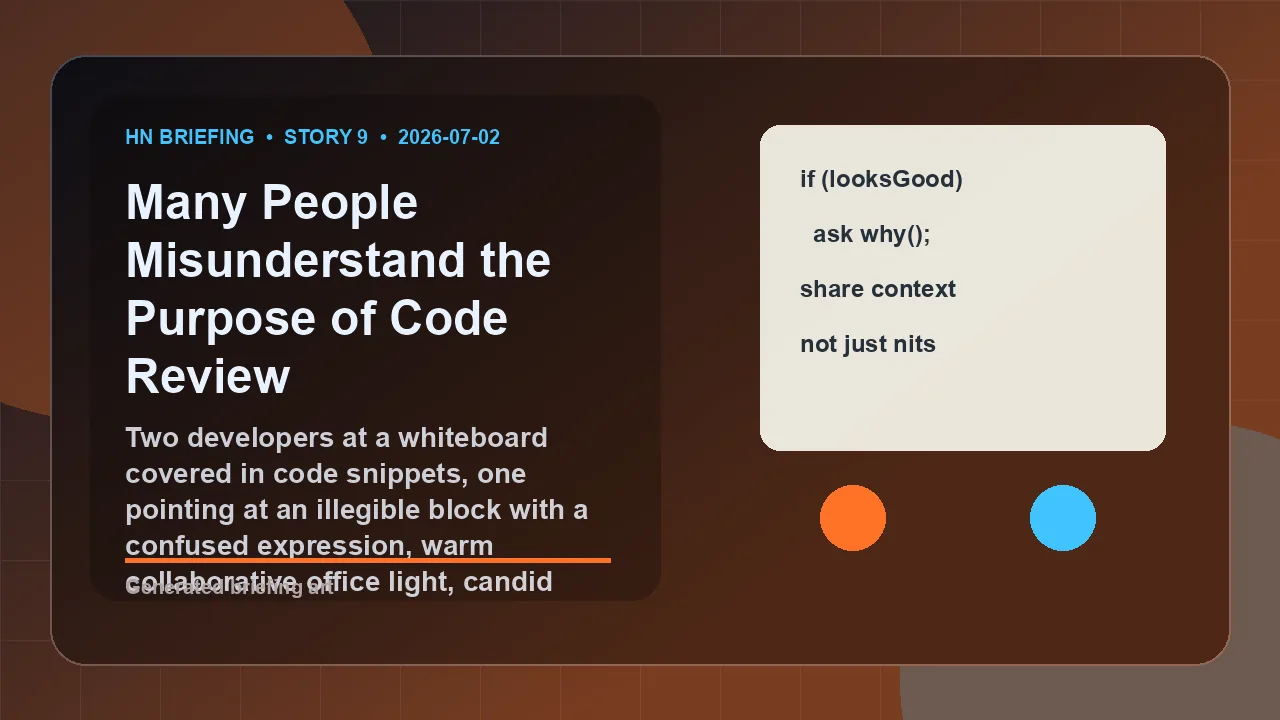
Mark Dominus argues bluntly that code review is not for finding bugs — which he says is largely impossible through inspection — but for identifying code that will be hard to maintain. The signal is simple: if a reviewer can't understand what a piece of code does, that's the problem, and it should be fixed while the author still remembers the reasoning. Short, pointed, and directly relevant to anyone building teams or shipping software.
Relevance 1/10Importance 3/10
Smithsonian Magazine profiles John Boepple, who recognized that freshwater mussel shells from Midwest rivers could produce high-quality pearl buttons, emigrated to the US, and by 1891 was running a factory in Muscatine, Iowa. The industry peaked at 1.5 billion buttons per year by 1905 — a stack 2,900 miles high — before plastic made it all obsolete and the mussel populations were devastated. It's HN being HN: a genuinely compelling history of industrial disruption that doesn't involve a single GPU.

 HN Briefing AM


/https://tf-cmsv2-smithsonianmag-media.s3.amazonaws.com/filer_public/ef/3b/ef3b4417-2b07-4c6d-8f69-6ca044e305a5/ebony_shell_to_buttons_copyright_historic_muscatine_inc.jpg)