Relevance 9/10Importance 7/10
A senior director at GitHub automated 40 recurring tasks using GitHub Copilot's scheduled-automation feature, wiring AI agents into her calendar, email, messages, and repos to handle meeting prep, follow-up tracking, and triage. By offloading the operational noise, she freed up bandwidth for the genuinely human parts of leadership. Her line says it all: automations handle the scaffolding, she does the human work.
Relevance 8/10Importance 8/10
F3 is an open-source columnar storage format aiming to fix the limitations of Parquet and ORC by embedding WebAssembly decoders directly inside the files themselves. That means files can carry their own decoding logic, staying readable across platforms without native decoder support and letting new encodings ship without breaking compatibility. It's a genuinely clever swing at making data formats future-proof.
Relevance 8/10Importance 6/10
FUTO Swipe is an open-source, privacy-preserving swipe-typing system built from three cooperating models — an encoder, a context language model, and a decoder — that together weigh in at just 2.5 million parameters. Everything runs on-device, and the team released a million-swipe dataset under the MIT license to help the community build on it. It's a neat reminder that you don't always need a giant model to get great results.
Relevance 7/10Importance 5/10
Artist Dany Bittel teamed up with startup crysta.ai to turn one of his 3D insect Gaussian splats into a physical object, voxelating the splat data and printing it layer by layer into a transparent crystal-like sculpture. He calls the result a modern version of amber that reveals fine detail when backlit. There are still rough edges — fur transparency is hard — but it's a striking bridge between neural rendering and physical objects.
Relevance 6/10Importance 7/10
The Swift Package Index, the community-built directory for discovering and vetting Swift packages, is joining Apple. The move folds a key piece of Swift's open-source ecosystem infrastructure directly under the company that stewards the language. It's a significant consolidation for the Swift developer community.
Relevance 3/10Importance 5/10
The author pushes back on the now-fashionable take that vitamin D does nothing, arguing the randomized trials actually point to modest benefits for people who start out deficient. Between biological plausibility, our ancestors' higher baseline levels, and weakly positive trial data, the conclusion is that supplementing when you're low-ish is probably wise. It's a measured middle path between hype and dismissal.
Relevance 3/10Importance 7/10
Deutsche Bahn suspended train service nationwide after a malfunction in its GSM-R digital rail radio system, stranding passengers at stations while technicians scrambled to restore communications. Swiss rail was largely unaffected. It's a stark illustration of how a single communications layer can take an entire national network offline.
Relevance 3/10Importance 6/10
A second front-page report on the same Deutsche Bahn outage adds detail on the radio interference behind the GSM-R failure, with trains held and passengers waiting as crews worked the problem. The redundancy on the HN front page underscores how much attention the disruption is drawing. For a digital radio system that's supposed to be rock-solid, this is a bad day.
Relevance 4/10Importance 4/10
A developer skewers the practice of validating email addresses by firing off unsolicited messages to see if they bounce. The approach is self-defeating: it either confirms an address by delivering spam, or fails when content filters reject the message — wasteful either way. A pointed reminder that "does this inbox exist" shouldn't mean spamming it.
Relevance 2/10Importance 4/10
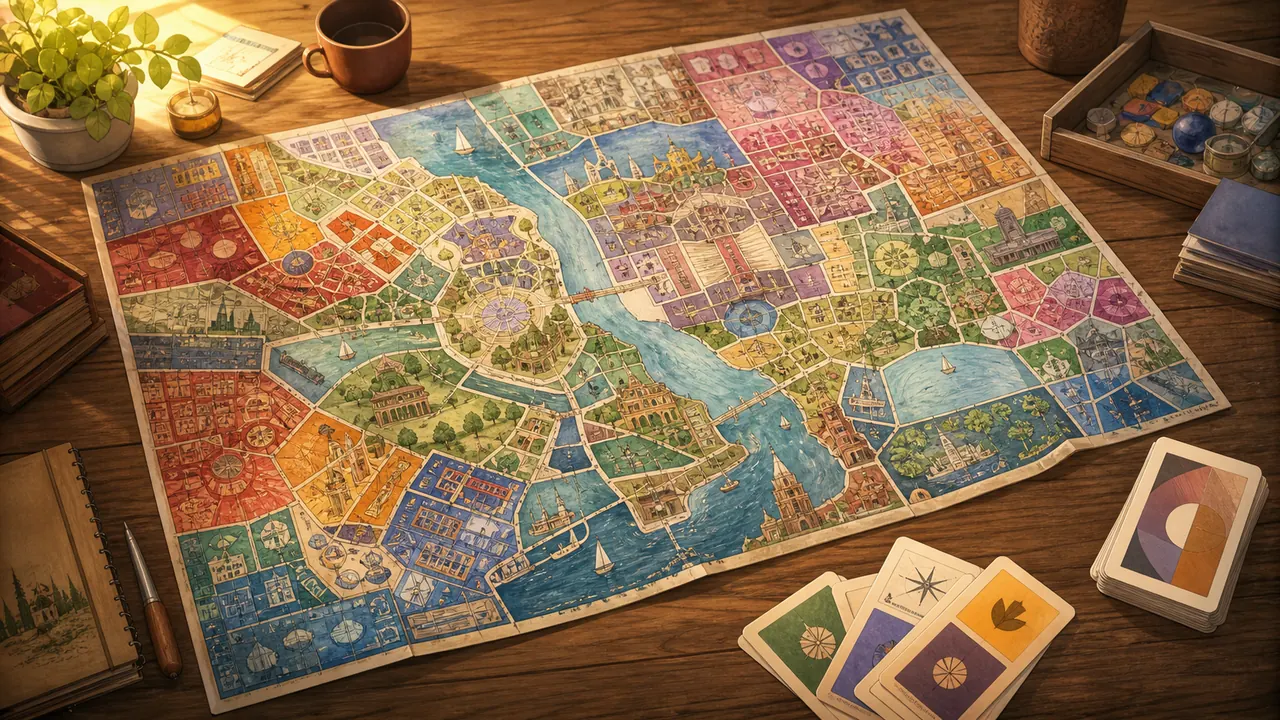
Jerry's Map is an art project Jerry Gretzinger started in 1963, drawing an imaginary city that has since grown into a two-dimensional virtual world of more than 4,000 hand-made panels. The work evolves through an elaborate rule system driven by a custom deck of cards that issues randomly generated instructions. It's a procedurally generated world built decades before that was a buzzword — generative art the analog way.

 HN Briefing PM