Relevance 10/10Importance 9/10
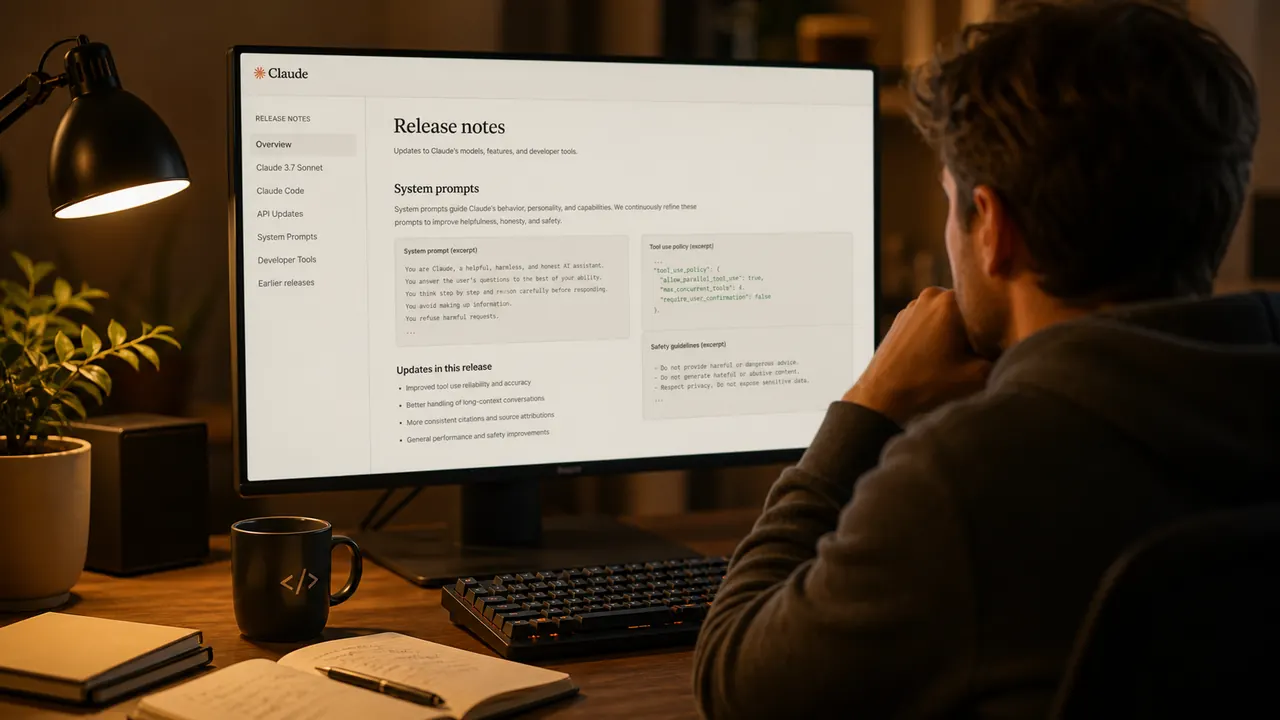
Anthropic published the actual system prompts used in Claude's consumer apps, and the release notes reveal new model tiers including Fable 5, Opus 5, and the restricted Mythos 5. Notably, both Fable 5 and Mythos 5 were suspended June 9 through July 1, 2026 due to U.S. export controls. API users are unaffected since API access uses fixed model snapshots with stable, versioned system prompts.
Relevance 10/10Importance 8/10
Walter van der Giessen argues AI labs are deliberately offloading factual knowledge from model weights in favor of stronger reasoning procedures — a strategic architectural choice, not a flaw. Facts go stale and require expensive retraining; reasoning stays timeless and compresses efficiently. The end state he envisions is models functioning as pure reasoning engines paired with dynamic retrieval systems for current information.
Relevance 9/10Importance 8/10
Matt Lenhard investigates a gray market where intermediaries buy unused AI API credits from startups and resell them at 30 to 80 percent discounts, operating across marketplace sites, routing proxies, and Telegram groups. One broker claimed $100,000 in daily spend capacity, and Lenhard estimates tens of millions of credits circulating in these channels. He expects AI providers to crack down as they grow more cost-conscious.
Relevance 9/10Importance 6/10
MathCode is a terminal-based AI agent that accepts natural language math problems, formalizes them as Lean 4 theorems, then iteratively generates and validates proofs using a persistent Lean REPL to minimize recompilation overhead. It maintains a cumulative library of proven theorems reusable in future proofs, and can parallelize complex goals across multiple proof strategies simultaneously. Available now for macOS arm64 and Linux x86_64.
Relevance 7/10Importance 5/10
Ivan Gavran revisits a 1979 paper dismissing formal program verification as unworkable, asking whether AI-driven coding tools have changed the calculus. He argues specifications have become more valuable in the AI era, not less — giving humans a precise language for communicating intent to coding agents generating code at machine speed. His conclusion: formal methods deserve a serious second look, even if the original critics weren't entirely wrong.
Relevance 2/10Importance 6/10
Armstrong Subero, an embedded engineer from Trinidad and Tobago, pushes back on a viral RISC-V architectural critique, arguing it misses the technology's most transformative advantage: genuine accessibility for developers in underserved regions. RISC-V spans from ten-cent CH32V003 microcontrollers to full Linux-capable SoCs, with optional ISA extensions providing scalability without ARM's royalty structure. For developers facing $60 to $200 shipping costs and limited tooling access, RISC-V's openness is the whole point.
Relevance 1/10Importance 7/10
On August 13, 2026, Unit 1 at Florida's St. Lucie Nuclear Power Plant was manually shut down after three control rods dropped into the reactor core while operating at full capacity. The NRC classified it as a non-emergency, and operator NextEra Energy reported the trip was uncomplicated with all systems responding normally post-trip. Unit 1 was stabilized in Hot Standby mode and subsequently returned to full power after the equipment issue was resolved; Unit 2 was unaffected throughout.
Relevance 3/10Importance 5/10
Buf Technologies released the first fully-featured Language Server Protocol implementation for Protobuf, bringing modern IDE features — code completion, go-to-definition, reference finding — to VSCode, IntelliJ, and Neovim. The implementation uses Buf's protocompile frontend with a new incremental compilation architecture that catches errors protoc misses entirely. Future plans include automatic import fixing and Protovalidate support.
Relevance 2/10Importance 3/10
This deep-dive traces MMX as SIMD's first mainstream x86 consumer implementation, arriving with the Pentium in 1997 and providing eight 64-bit registers for operations like adding eight bytes with a single instruction. The piece covers MMX's key constraint — you couldn't mix MMX and floating-point code without explicitly issuing an EMMS instruction to clear registers — and its lineage running through SSE and SSE2 to modern AVX-512.
Relevance 1/10Importance 3/10
The Low-Tech Lab wiki covers construction and use of DIY ceramic pot water filters built from clay, combustible material like rice husks or sawdust, and colloidal silver — capable of filtering bacteria and protozoa from drinking water using locally available materials at minimal cost. It's a well-documented humanitarian technology replicable without industrial manufacturing. The page itself returned a 403 during fetching, but the Low-Tech Lab format typically includes step-by-step construction guides and field validation.

 HN Briefing PM