Relevance 10/10Importance 10/10
OpenAI is opening a limited preview of GPT-5.6 Sol, its new flagship, alongside cheaper Terra and Luna tiers, claiming state-of-the-art results on coding, scientific reasoning, and cybersecurity. New "max reasoning effort" and an "ultra" mode that spins up subagents push the frontier on long-horizon work, with Sol priced at $5 input / $30 output per million tokens. Notably, access is restricted to a small group of partners in Codex and the API — OpenAI says that's at the request of the US government.
Relevance 10/10Importance 9/10
Commerce Secretary Howard Lutnick lifted export controls that had temporarily blocked Anthropic's powerful Claude Mythos 5 model, clearing it for release to more than 100 vetted US institutions. The hold stemmed from security concerns about misuse and unauthorized access by China-linked entities. The move cements an emerging framework where the US government effectively gates who gets frontier AI — the same dynamic now shaping OpenAI's GPT-5.6 rollout.
Relevance 9/10Importance 8/10
AWS Lambda introduced MicroVMs, a serverless primitive for running user- or AI-generated code in isolated, stateful environments with VM-level security. It targets AI coding assistants and interactive dev platforms that need to safely execute untrusted code while keeping fast startups and persistent sessions. By splitting the difference between containers and full VMs, it removes the need for teams to roll their own virtualization stack.
Relevance 5/10Importance 4/10
Fusion is a transpiler that lets developers write a library once and compile it across many targets — C, C++, C#, D, Java, JavaScript, Python, Swift, TypeScript, and OpenCL. It generates lightweight, human-readable code with no virtual machine, emulation, or dependencies. The pitch is efficient reuse of a single implementation across very different language ecosystems.
Relevance 4/10Importance 4/10
A deep dive shows that pushing DEFLATE to level 13 shaves only about 0.134% off file size versus level 12 — roughly 87 kilobytes — while running about 56 times slower. It's a sharp illustration of diminishing returns at the extreme end of compression. The author argues such effort only pays off when data is compressed once and distributed widely.
Relevance 3/10Importance 4/10
Novelist Robert J. Sawyer makes the case that WordStar, the DOS-era word processor from 1978, is still superior for creative writing. Its control-key interface keeps a writer's hands on the home row and treats the document like a long-hand manuscript rather than a typewriter. The result, he argues, blends writing and editing in a way modern apps never quite replicated.
Relevance 2/10Importance 5/10
The open-source transport-sim classic OpenTTD shipped its first beta of version 16, headlined by the long-requested ability for trains to drive backwards. The release also brings smarter map generation, subsidies that work with cargo distribution, customizable NewGRF collections, and a cleaner UI with filtered dropdowns and consolidated vehicle previews. It's a testing build inviting the community to shake out bugs before the stable cut.
Relevance 2/10Importance 4/10
A hardware hacker reverse-engineered IBM's MCGA chipset from early PS/2 machines, documenting the memory controller and video formatter gate arrays. Working from die images, they extracted netlists, mapped undocumented registers and test modes, and published KiCAD schematics. Next up is generating Verilog from the recovered designs — a path toward modern reimplementation.
Relevance 1/10Importance 3/10
A perennial physics question resurfaced on the front page: why is kinetic energy proportional to velocity squared rather than just velocity. The accepted explanations lean on the work-energy theorem and the fact that energy must be frame-consistent and conserved across collisions. It's a clean reminder that the quadratic term falls right out of integrating force over distance.
Relevance 1/10Importance 2/10
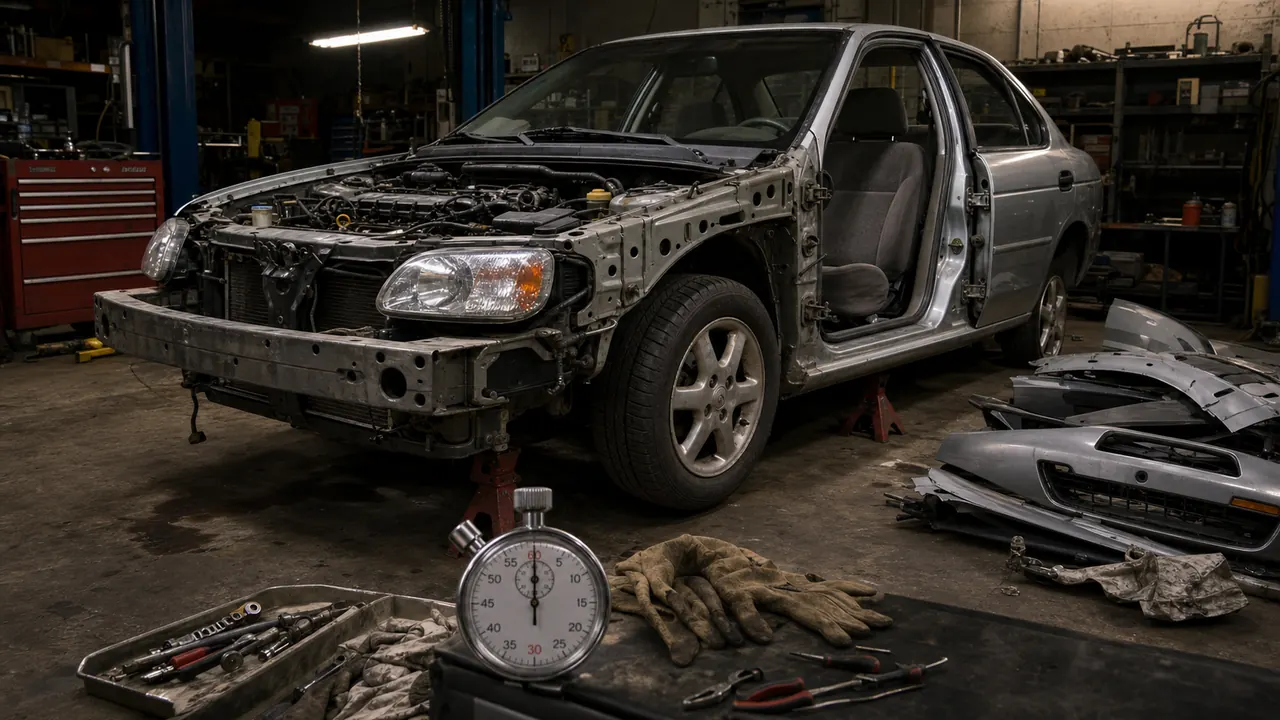
A nostalgic Sport Compact Car magazine piece resurfaced in which the staff took a styled-up 2001 Nissan Sentra and stripped it down on a zero-dollar budget. By shedding weight and unnecessary parts, they dragged the quarter-mile time from 16.3 seconds down to 14.3. It's a hands-on lesson that subtraction can be the cheapest performance mod.

 HN Briefing PM