Relevance 10/10Importance 10/10
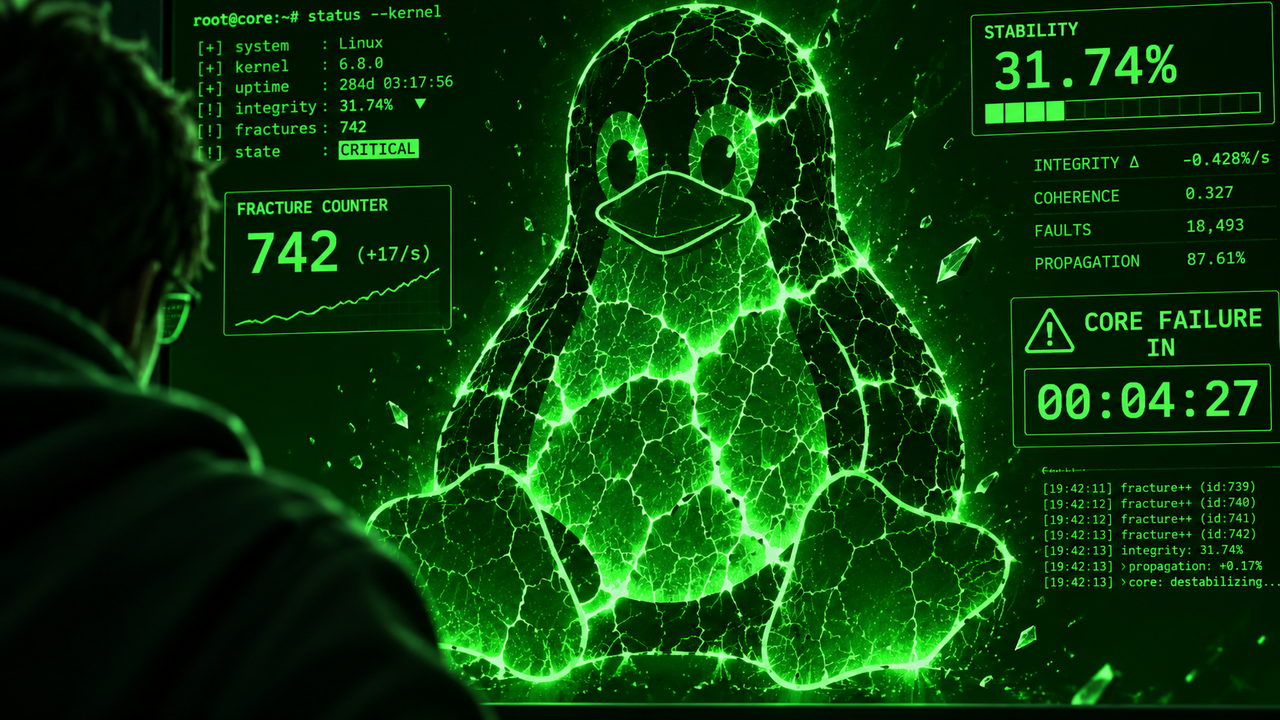
OpenAI says an autonomous agent pipeline powered by an unreleased cyber model found and reproduced 948 distinct Linux kernel privilege-escalation bugs in a single roughly 30-hour run, inventing at least ten novel exploitation techniques along the way. The run cost about $1.2 million in API credits against bug-bounty value estimated at $19 million to $66 million. Scout agents narrowed the audit to 5,034 targets covering 2.8 million lines of kernel code, about seven percent of the codebase.
Relevance 10/10Importance 10/10
In an updated SEC filing and follow-on commentary, Anthropic says Claude now writes more than 80 percent of the code merged into its own codebase — over 90 percent of contributions in September — and that AI-driven acceleration of AI development is arriving faster than expected. The company says it may soon meet its Responsible Scaling Policy threshold for "dramatically accelerated progress attributable to AI," while stressing no current model has been designated as crossing it.
Relevance 10/10Importance 9/10
Moonshot AI published the full weights of Kimi K3.1 Pro on Hugging Face: a 2.8-trillion-parameter mixture-of-experts model with 104 billion active parameters per token, a 1,048,576-token context window, and native image input via MoonViT-V2. It's 96 safetensors shards totalling roughly 1.56 terabytes, with no access form or waitlist. It scores near the top on Terminal-Bench 4.0 at 65.7 percent and eclipses DeepSeek V4 Pro as the largest open-weight model by total parameters.
Relevance 9/10Importance 9/10
OpenAI, Google, Microsoft, and Anthropic have agreed to honor a single machine-readable signal — the `__usage_ai-training` token in robots.txt — letting publishers block their content from model training with one line. Anthropic is already honoring it, Microsoft starts February 1, 2027, Google rolls out during 2027, and OpenAI says support arrives in coming months. The catch: it doesn't remove anything already scraped into existing datasets or trained models.
Relevance 9/10Importance 9/10
Six METR staff have been onboarded with company hardware, office space, and internal tool access roughly on par with Anthropic's own risk-assessment teams. METR can publish its analysis of Anthropic's risk levels, incidents, and practices without company veto, and can publicly characterize any redactions it disagrees with. It's the top rung of a new three-tier evaluator framework, and METR is so far the only occupant.
Relevance 9/10Importance 8/10
Anthropic reported that bacterial and bacteriophage relatives of the major vault protein self-assemble into vault particles in E. coli, with Claude helping map a phage-derived shell at 3.2-angstrom nominal resolution. Using Claude Science, the team searched roughly 15 billion predicted proteins and found vault homologs across 29 bacterial and four archaeal phyla. A small team with little structural biology background did it in under four months; the report is headed to bioRxiv.
Relevance 8/10Importance 9/10
Alphabet's DeepMind spinout is negotiating a roughly $5 billion raise that would value the AI drug-discovery outfit at about $50 billion, per Bloomberg. The round isn't closed and terms could change. Notably, Isomorphic is still entirely preclinical — Demis Hassabis said in January he expected first clinical trials by the end of 2026, and the company raised $2.1 billion in May led by Thrive Capital.
Relevance 7/10Importance 9/10
Published today, OpenAI's National Community Compact and Compute Campus Policy Blueprint respond directly to a midterm week in which local voters approved data center moratoriums across dozens of ballot measures. OpenAI commits that company-owned campuses will cover both their electricity and the infrastructure to supply it, will publish construction plans and water and power consumption, will commission independent noise studies, and won't require public officials to sign NDAs. The blueprint asks lawmakers to codify those same rules for everyone else.
Relevance 8/10Importance 7/10
Meta acquired Conductor, a 2024-founded startup whose app lets engineers run and supervise several coding agents at once — terms undisclosed. CEO Charlie Holtz and CTO Jackson de Campos join Meta. Existing features keep working into early next year, but Conductor's cloud service shuts down November 20 and customer cloud data starts getting deleted after that.
Relevance 7/10Importance 7/10
Apple cut some engineers' daily AI spending allowance from $300 to $200 last month and is weighing a further drop to $100 for certain teams, with non-engineering staff facing tighter caps still. The trims are part of CEO John Ternus's broader cost-cutting push. Apple engineers lean heavily on tools like Claude Code and ChatGPT, where token costs scale with exactly the kind of long agentic runs that make them useful.